

This is essay is part of a series, but it can be read independently. The first part, “Looking for Alice,” I wrote for two friends who wanted to know how I thought about finding someone to share your life with. The second part, “Dostoesvky as lover,” was about open dialogue in relationships.
Relationships are coevolutionary loops
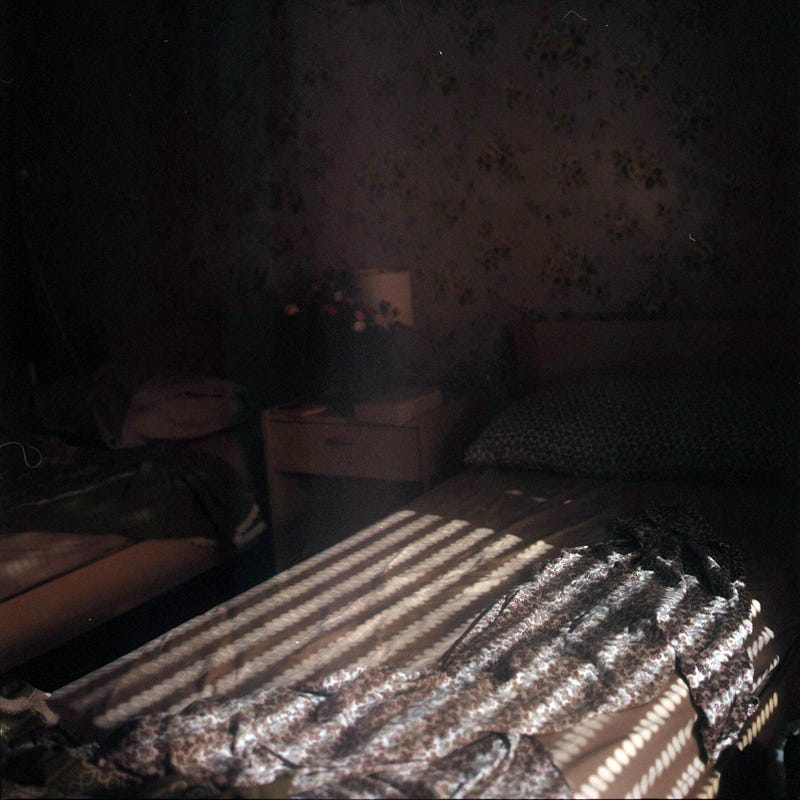
A polaroid photo by Andrei Tarkvosky
“Dependence is scorned even in intimate relationships, as though dependence were incompatible with self-reliance rather than the only thing that makes it possible.”
― Maggie Nelson, The Argonauts
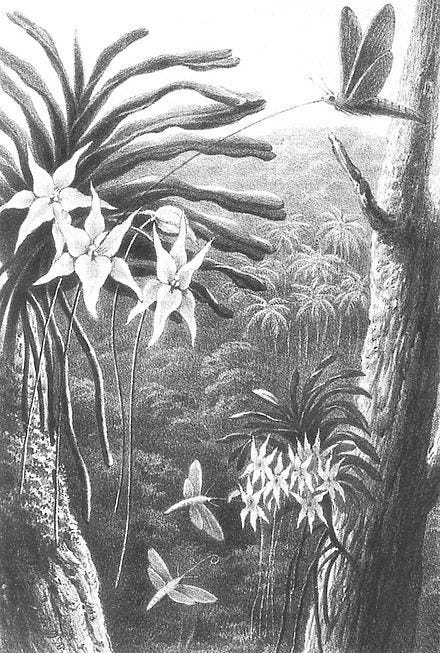
When I meet a person who is truly, profoundly themselves, I sometimes think of a letter Charles Darwin sent to Joseph Hooker in January 1862 after receiving a package of orchids.
“Good heavens,” Darwin wrote about the Angraecum sesquipedale, an orchid from Madagascar with a nectary as long as his forearm, “what insect can suck it?”
There must exist a pollinator moth with a tongue longer than any that has ever been observed, he conjectured later. The moth and the orchid must have evolved in dialogue.
This is what I infer when I see someone who is comfortable in their unique strangeness, too. There probably exists someone who enabled that evolution of personality. A parent, a friend group, a spouse. It is rare for people to come into themselves if no one is excited and curious about their core, their potential. We need someone who gives us space to unfold.
For me, this is Johanna. We first met when she was 21 and I was 22 and later became a couple. What is me in me has unfolded primarily in her company. This has been a mutual unfolding; we spoke each other into being.
This essay is about how we made our first home together. By home I don’t mean just the physical structure, but the emotional space in which the coevolutionary loop plays out.
Constraints and creativity
In December 2014, Johanna and I were sitting at the bus station in Cochabamba, central Bolivia, talking about our future. We’d been a couple for 18 months at this point. The last ten weeks, we’d spent moving between empty hotels along the Peruvian coast and up the Andes, scribbling in our notebooks, reading, getting to know each other better. In another two weeks, we’d be heading home.
I was happy with the way my life was back home—living in a small Swedish city, writing, and letting life carry me along. When I imagined the future, I saw myself at my desk, as I sat every day, typing poems. As for the city outside the window, I vaguely assumed it would gradually transform into New York or some such place. Not that I cared about cities, or anything much beyond books and conversations, but I figured with the self-assurance of a 23-year-old that if I kept writing, the natural thing to do was to let myself be sucked up into the literary world.
Johanna was clearer about what she wanted from life. She wanted to live frugally, she wanted to have the autonomy to pursue her interests without thinking about money, and this meant she was going somewhere no one wanted to live so rent was cheap.
This was what we were discussing at Cochabamba bus terminal, while ticket sellers announced their services by singing the names of destinations, their voices weaving together into a soft murmur under the arched sheet metal roof.
Having diverging goals was the sort of thing that had, in previous relationships of mine, been a source of conflict. But with Johanna, there was rarely such friction. It was more like our conflicting needs were two equations, and our task was to figure out where they intersected; the hardness of the problem wasn’t personal.
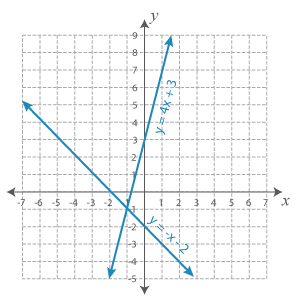
Now, it wasn’t obvious that our lives would have a solution that satisfied both. Sometimes people intersect at one point in time and love each other, but then the arrows of their lives continue in separate directions. When I contemplated this possibility, I saw myself sitting in New York at 40, Johanna somewhere in the forests where Sweden bleeds into Norway, both thinking, it didn’t really get better than that.
But was there a solution?
It was hard to tell, but this wasn’t necessarily a disadvantage. The hardness of the problem might even be a good thing, I figured: it would force us to be more creative. When you write classical poetry, you impose strict rules on yourself to deliberately make it harder to say what you want—and this is what makes poetry come alive. W.H. Auden, the British poet, praised metrical rules because they “forbid automatic responses, force us to have second thoughts, free from the fetters of Self.” The same thing is true for relationships, I reasoned: I could chart a path through life that made no compromises for others, and it would go where I wanted it to; or I could impose the much stricter rigor that comes from aligning my trajectory with Johanna’s, seeking mutual flourishing, and I’d be surprised where life would take me.
“Here’s an idea,” I said, taking a napkin I had stuffed in my pocket when we ate breakfast at the Calama market. I drew a blueprint of my mother’s parents’ house.
“I figure they will move out in a few years,” I said. “We could wait for that and buy their house.”
It was not going to be as cheap as the stuff Johanna had in mind, but we could buy it off market—it might be within our shared budget, and it was close to the city and the airport. Moving to the small town where my mom grew up? It seemed like a lame direction for our lives to take. But the more we spoke about it, the more it seemed to fit.
I got up, walked over to the internet café, and checked my email. Mom had written.
My grandparents were selling the house.
A relationship is a coevolutionary loop
Two truths approach each other. One comes from inside, the other from outside,
and where they meet we have a chance to catch sight of ourselves.
—Tomas Tranströmer
The house, built by my grandfather and two teenagers he hired in 1957, was conceived as a simple cube of bricks perched atop a small hill. But over six decades, it had grown and changed, adapting to its environment and its inhabitants. My grandfather bricked over a window to make the living room easier to furnish. A door was moved, walls put up. In the 1970s, a new wing was added, going out at a southwestern angle to create a warm, shielded terrace on the backside, where they could grow grapes and block out the prefabricated houses that were creeping up around them.
This process of gradual adaptation, which Stewart Brand calls how buildings learn, is a type of coevolutionary loop, like that which fitted the orchid to the moth and vice versa: the house was changed to fit my grandparents’ life, but the house also changed them.
Because of this loop, the house, when Johanna first visited in February 2015, felt deeply human in a way that new houses do not. The design choices were layered with insights that had occurred over decades of lived experience. It was an architectural manifestation of my grandparents.
When they went out into the kitchen to put on coffee, leaving us alone in the living room, Johanna silently mouthed, “Yes.”
Not all houses age like this. For it to happen, the mathematician and architect Christopher Alexander writes, the design must allow you to “mess around with it and progressively change it to bring it into an adapted state with yourself, your family, the climate, whatever.” Often, modern houses make this harder. They force you to live inside a preplanned, static vision. Unresponsive to your evolution, they alienate.
There is a corollary for relationships. Some relationships are hard, or even impossible, to change. As an individual, you grow—but your father won’t acknowledge that change or adapt to it, and the relationship gets stuck. Other relationships are fluid and open-ended, they grow to fit you better and better the more time you invest in them, like an old house where you rearrange the walls, doors, and furniture until the light falls just right.
Johanna is inherently on this more fluid and responsive side, that was one of the things that attracted me to her. She listens in a way that makes it possible for me to say things that I have not said before (she had this effect on my grandparents, too, getting them to share things I’d never heard them talk about: the hard years when the triplets were born; the years before running water when they’d sneak out to pee at night and bats would land on my grandma’s head, shining blonde in the moonlight). Johanna is conscientious about making sure she understands, asking many detailed questions. She listens, holding you to what you say. This made living and growing with her (relatively) easy.
Talking for hours every day, new insights would continually arise, and we could rapidly turn those ideas into reality. We were relentless. Everything we did was fast, it had been so since Johanna let me close. There was no holding back after we started hanging, no waiting to answer messages; there was an unbridled curiosity and openness towards each other, a shared longing to learn and develop in every way, and this led to a rapid progression. If our relationship was going to break, it was as if we wanted it to break fast.
It took us two months to go from talking about moving in together to signing the papers on the house. On the train back from the visit to my grandparents, I was on the phone with my father, discussing how to draw up the contract.
And then the loop went on: living in the new situations we created, we got access to new experiences which we rapidly brought to the surface. We kept on iterating. Changing our environment and our relationship, learning, and changing things again.
A note on speed
When I think about it, the speed at which we updated early on was probably more important than anything else. Iteration speed is key when you deal with feedback loops of this kind, when you want to figure out how to best understand and interact with an emergent reality. The best scientists aren’t those who are the most intelligent; they are the ones who tweak their theories further than others, in close contact with experimental reality. The most valuable startups didn't start with product-market fit. They kept learning and adjusting at a faster pace than those who fell behind. The same can be said of relationships. You need to keep a certain rate of improvement for things not to break. If you are too slow in adapting to each other, you grow apart. If you raise your iteration speed, you can go places you wouldn’t have guessed possible a priori. My life, at least, turned out much weirder than I had planned.
Looking at it like this, like a loop, one way to think about improving a relationship is to ask, how can we increase the cycle speed?
Can we learn more about each other sooner? Can we act on that knowledge faster? We have a long way to go and limited time.
Can we remove bottlenecks along the loop?
This is admittedly a strange and rather mechanical way of talking about relationships, and I do not, on the average Monday, think about me and Johanna in these terms. But it is a useful framing to think of a relationship as something you can iterate on and eventually become exceptionally good at. There is love in that care.
Experiments
The first month we spent in the house, my grandfather would walk straight in every day without knocking. After a month, he settled for the cellar. We sat in the kitchen and heard him go around down there, moving tools about. Later still, we saw him lurk on the path down the hill, watching the house from afar. He stopped a little further up the hill every day. Then, one day, he disappeared around the bend and never came back. He was done with the house.
It was the first time Johanna and I had lived together, so we spent much time talking about how to go about our lives. When we were thinking about getting internet, we said: well, what are the arguments for having internet? We listed them. The arguments didn’t convince us, so we spent a year without internet. Then we got 1 GB of data so we could check our email.
Many such experiments were made, where we had an idea and turned it into lived reality so we could evaluate it. The early experiments were often stupid. But it didn’t matter, because the few that worked for us (like radically reducing our use of the internet, like starting a blog) paid for all of the others, by opening up unseen possibilities. Experiments have capped downside but unknown upside.
I kept a notebook where I jotted down things I wanted to google and twice a week I’d go down to the local library, look at the list, and say, why on earth did I want to know Justin Bieber’s net worth? And then I’d go home again, to read and write, listen and talk.
Moving to the countryside was, in itself, an experiment. What it taught us: none of our friends wanted to visit the sleeper town that had grown up around my grandparents’ house.
We also learned that this didn’t bother us all that much. Once or twice a week, we’d go over to the senior apartment where my grandparents lived and talk about times when doctors arrived on sleds and kids slaughtered rabbits for profit, and once a week, we’d go into the city. The rest of the time was wide open.
We pulled bags of books home from the university library on the train every time we went to the city. I wrote a novel about people who changed bodies when they slept with each other and self-taught multivariate calculus and computer science. Johanna, who had studied to be a high school teacher, spent a year filling in the truly truck-sized holes in her education, reading the history and philosophy of education, learning psychology, and so on. After nineteen years in school, Johanna had her first meaningful education. She learned that she could set a direction, pose questions, and measure things she read against her needs.
We talked three or four hours a day, maybe more. We’d talk in bed in the morning about the school Tolstoy ran at Yasnaya Polyana; we’d talk about machine learning while walking the path in the woods where my grandfather had installed benches for birdwatching; we talked about talking.
Our lives have since become more complicated (living abroad with small children, renovating two houses, homeschooling, running this blog and a gallery with too many exhibition halls) so we don’t have the time to talk as much as we did back then anymore. This makes the importance of conversation noticeable to me. Whenever we drop below a certain level of talking, friction accumulates. We get more stuck in our ways, we get stressed and don’t have time to maintain the shared context necessary to understand each other. But this has, so far, been possible to reverse. Having talked an ungodly amount early on, we have reserves of shared language and trust. I sit down on the edge of the bed, where Johanna lies with the sleeping toddler. And after an hour, we are in the loop.
Debugging life
As the spring of 2015 became summer became fall became winter again, we settled into routines:
—the dish brush goes here;
—the trash can gets pulled to the road on Tuesday night;
—Sundays are for listing everything that went wrong during the week on the blackboard we painted on the wall of my study, so we can figure out what needs to change.
This latter habit was the most important. I was learning to program, and so I liked to think about our life as a piece of software. We had our routines and our principles, this was the code. We ran the code by living it. The list on the blackboard was the bug log, a record of the ways our routines broke down in contact with reality. We kept going through the code until our life did what we wanted it to do, more or less.
I wanted to try getting up at 5 a.m. and working for three hours before breakfast, but I kept sleeping in.
“Why is that?” Johanna said.
“I haven’t felt sleepy at night. So I stay up.”
We’d go through various reasons for that, and I’d decide to give up coffee and see if that helped. After a few weeks of tweaking, the morning would click into place. I’d wake up, take two steps, and sit down by my desk in the bedroom, working on mathematics as the sky slowly brightened, the bird song starting up.
The bug log was, I realize now, a way of making the coevolutionary loop explicit. Writing down everything that went wrong helped us pinpoint the bottlenecks, the frictions. It also forced us to put words to our goals, values, and assumptions, opening those up for discussion and refinement. Is that really what you want? What are you willing to give up to achieve it? How do you feel about it?
This, day after day, was how we grew a home.
I don’t want to give the impression that this always worked. Life repeatedly tripped us up and we fell out of the habit of caring and providing space for each other to unfold; we’re still falling in and out of it. But routines are something of a ratchet; the distance we fall is shorter each year.
When I look back at the kids who sat at the bus station in Cochabamba, I can barely recognize them. In photos, they look like us, yes, but their interiorities! Their interiors only vaguely resemble ours. But what is fascinating is that the thing that changed our inner lives came from within. I used Johanna’s words to rearrange myself, and this allowed me to say things that rearranged her, again and again. It was the house growing in a coevolutionary loop with its inhabitants. It was the moth and the orchid.
Acknowledgments
The discussion about coevolutionary loops was shaped by converastions with Alexander Obenauer, whose research can be said to be about what it would mean for computer interfaces to enable coevoltionary loops with the user. Rhea Purohit helped me sort of the tangles of my first draft. And always, Johanna.

Dostoevsky as lover

This is the second part of a series that began with Looking for Alice. You don’t have to read that to understand this. But it’s cute. A summer ten years ago, I spent all day every day talking to Johanna. We were 23. Her laughter was like a shotgun. She could lure out a hidden richness from the people she met: faces that would have just passed me by in the street with Johanna turned into characters in a Doestoevskian novel.
Brilliant. Just brilliant. So fascinating to follow you and Johanna's story, and I love how you tell it with such clarity and transparency. I feel like I should make a note of all your relationship advice for future use.
Really enjoyed the "I jotted down things I wanted to google and twice a week I’d go down to the local library, look at the list, and say, why on earth did I want to know Justin Bieber’s net worth?" And as you figured, I loved the part about your grandparents.
this was a beautiful read, henrik. as i navigate my own relationship with a partner, i especially loved the idea of aligning our separate goals/visions by looking for the points at which they intersect. thank you for sharing :)