

This is the fifth part of a series on relationships begun with “Looking for Alice” (which is about how I met my wife Johanna), “Dostoevsky as lover” (about our early years together), “Relationships are coevolutionary loops,” and “When I accept myself as I am, I change.”
Love is to be invested in someone’s continual expansion
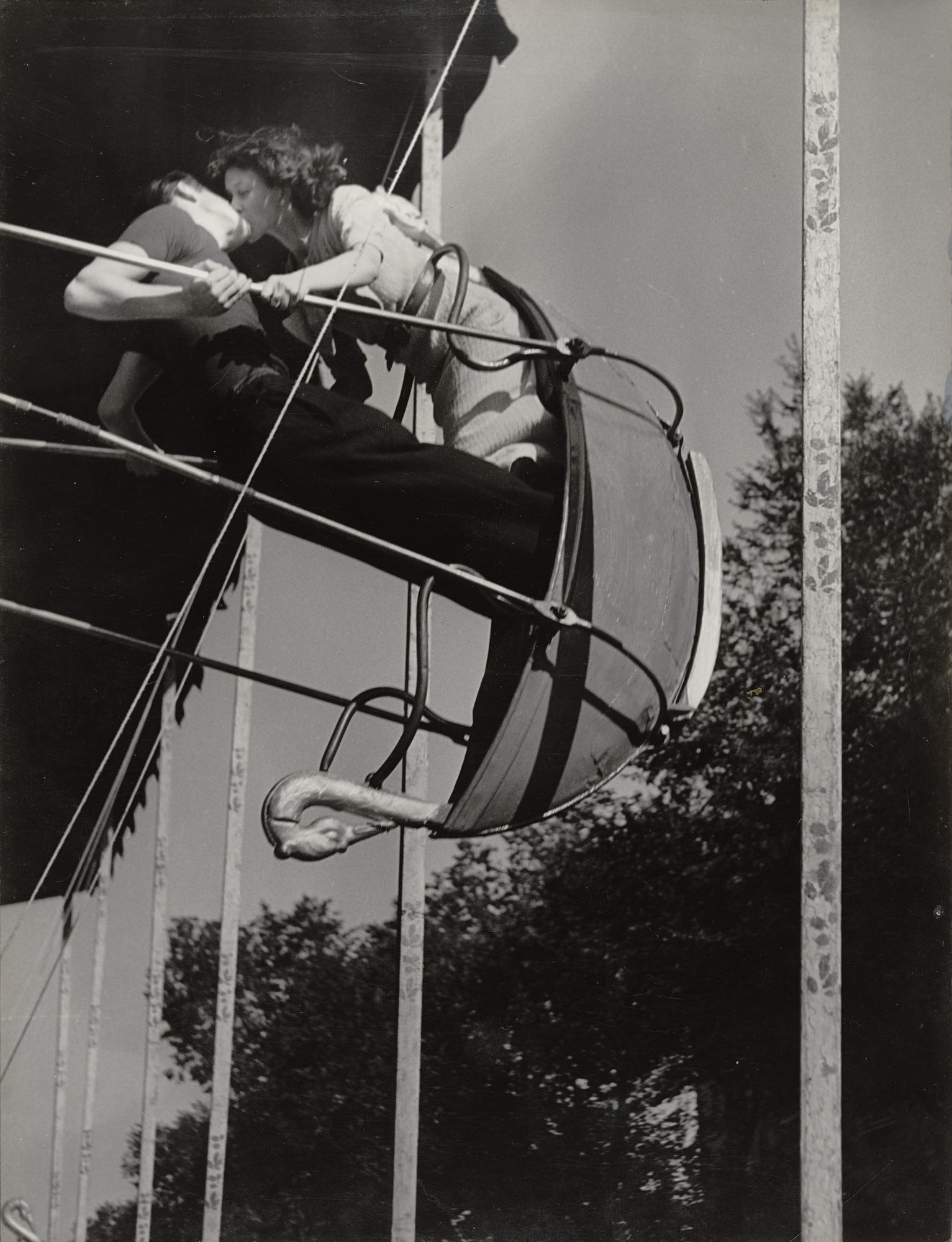
Kiss on a Swing at a Street Fair, Brassaï (Gyula Halász), c. 1936
When we moved to the farm on the island, Johanna and I had been together for eight years, had a 3-year-old in tow and a second one on the way, but were despite this still kids, basically. For example, we had, for no reason at all, assumed that there’d be firewood at the house. It was February. The wind coming in from the sea at 60 feet per second was blowing long tongues of snow across the roads. When we realized our mistake—the former owner had only left ten logs to help us through the first hours—we were already snowed over.
We pulled a sofa right up to the fireplace, where we burned a single log, and slept with beanies on our heads and every piece of cloth we could find wrapped around us—a little cave of blankets, where we lay with the three-year-old tucked in between us, laughing darkly at the fact that our breath rose white above us.
Johanna and I had met in our early twenties in Uppsala, outside a bookstore. The impression she had made on me was endearing but perplexing: the precision of her attention and the intensity of her curiosity were unlike anything I had seen, and yet, despite this, as I discovered later, she was surprisingly ignorant. If I mentioned the First World War, back then, she would say, “When was that, again?” But if I talked about an area I was researching, it would take her five minutes of insistent questions to cut through to the deep, underlying insight that had eluded me for months. In clinical terms, she was a nerd who didn’t know she was a nerd. And when she discovered this about herself, through us meeting, it felt, she says, like coming home.
Being young and lost, we made our relationship into a cocoon, a place where we felt safe enough to… well, what is it that caterpillars do in cocoons really? Dissolve themselves into a nutritious soup and assemble a new self.
Johanna says I made her realize that she didn’t need anyone’s permission to pursue her curiosity. I say she took that and just ran with it—lugging home shopping carts’ worth of books from the university library, self-teaching everything she felt she lacked, doing her own research. The first half-decade, as we moved in together and had our first child, was an explosion of Becoming. Johanna grew and changed beyond recognition, leaving the girl I had fallen in love with behind to transform into deeper versions of herself. The idea that led to the island was, in many ways, something I had nurtured out of her.
This is one of the joys and challenges of love: the more skillfully you love someone, the more held, encouraged, and accepted they feel, the more they change. If you love someone well, you have to run to keep up, growing your heart to hold what they are growing into. And this can be challenging. The direction of their change and the speed of their change can be the wrong direction and the wrong speed for you. There is no guarantee that another person’s growth aligns with what you want; sometimes you just grow apart.
But lying on the sofa watching our breath rise and mix that first night in the house, I could confidently say that that was not a problem for us. The challenge of aligning Johanna’s transformations and mine had been invigorating. Each time she’d grown and changed, I had felt something open up in myself. Her changes had become prompts that pushed me toward a higher, truer version of myself, just as my changes had been for her. Change answering change, it was a virtuous loop.
But then, the first spring on the farm, the loop fell apart.
Spring
The change was so small that it seems silly to even mention it. It was the plants.
As the land woke in spring, first anemones, then bluebells shooting up everywhere, Johanna had a deep, bodily reaction to the landscape we’d moved into. The land had spirit. It had good bones. She became increasingly occupied by the idea of making a great garden. She felt an urge to study flora and horticulture and color perception and design theory. This was a completely new direction for her.
I was happy to see her excited, and I tried to be supportive. But my happiness was of the abstract kind; I couldn’t actually relate to what she was feeling. I found the flowers boring.
We had taken on a mouthful by moving to another country, and, after the birth of Rebecka in July, taking care of two kids 24/7, while trying to create space for our interests as well. We were so, so tired. When the kids slept, Johanna just wanted to sink into her gardening books; it was a room of her own where she was free to choose direction without having to provide care for others.
To many, this might not sound like a problem. But our relationship had always been defined by a constantly ongoing conversation about things that excite us. Long, sprawling conversations were how we refilled our emotional reserves.
Now, there wasn’t much time for it. And when there was, we struggled. We struggled because I found it hard to talk about the one thing she had on her mind. I didn’t even have the language to understand what filled her with joy (it was literally Latin a lot of the time—names of plants). Moreover, making things worse, I had recently started a blog, which occupied me a lot, and I was very insecure about that so I didn’t want to let Johanna in on that yet, and so we couldn’t talk about what I was doing either. After a while, it was as if we lived a thousand miles apart in the same house.
“One loves that for which one labors, and one labors for that which one loves,” Erich Fromm wrote in The Art of Loving in 1956, and though I hadn’t read that book at the time, I lived by that maxim. Trying to show my love, bringing us closer, I would get myself involved in her projects. I cut down half an acre of false spirea shrubs that were spreading around the house. I learned to handle a chainsaw and cleaned up the woodlands, felling ugly pine trees, which I then cut up and sharpened into poles and sunk into the meadow to make a fence for the kitchen garden. It was the kind of work that makes your body so sore you walk funny.
I would stand, sweating and heaving in the high grass, and look at the trial beds Johanna was making. There were wild poppies and sprawling yellow-flowered bushes filled with butterflies. In a field of strawberries, our kids crawled around filling a colander to the brim. It was, objectively speaking, wonderful, sweet, life-affirming. But I just didn’t care for it. I missed Johanna.
Ever-morphing Others
The other day, Arnaud sent me an essay by Derek Thompson about being a Dad. In the piece, Thompson is trying to explain to a childless person what it’s like to have a child, and one of the metaphors he uses is that it is like being in Paris, except the city’s layout gets redrawn every night.
Imagine that every day you wake up in your left-bank apartment and the city has meaningfully morphed into some magically strange variant of Paris. On Tuesday, the streets and boulevards no longer meet at their old familiar intersections. On Wednesday, the Louvre moves to another arrondissement. The Arc de Triumphe [sic] turns upside down on Thursday and floats in the sky on Friday. Now we’re talking. Now that is more like parenting. To be a parent is to be a permanent tourist in a constantly evolving foreign city, which also happens to be your home.
This experience, which I can relate to when it comes to Rebecka and Maud, is a sped-up version of what happens in any relationship. The way an adult will change in a year, an infant will sometimes change in a day. “Parenthood abruptly catapults us into a permanent relationship with a stranger,” as Derek Thompson quotes from Andrew Solomon’s Far From the Tree. The act of caring for this ever-morphing stranger teaches you valuable lessons about love.
With your children, it becomes very clear that the love you feel has little to do with who they are or what they do. You love them, or at least feel like you ought to love them, almost no matter how much they mess up, and no matter what they decide to do with their one life—no matter what they metamorphose into.
In more superficial relationships (say, with a sales clerk), you assign value to the other person because of what they do (if they are helpful and do the things you want them to, you value them). But with your children, the value, to a large extent, flows in the other direction: you might hate soccer, but if your daughter loves it, you will assign it value and will go out of your way to drive her to soccer training and might even watch the World Cup together. Your love of your child is not motivated by something else you value; it is unconditional.
Adult love isn’t fully unconditional like this. There are things you would never value, even if your lover does, and there are things they could value that would make you stop loving them. But still, there is a sense that to love someone means to extend your care to the things your partner cares about to some degree. Just because she is she, and I am I, what Johanna values is valuable to me. I might never love gardening the way she does, but to completely shrug it off (or worse, to lose interest in her because she no longer is into the same things as I) would feel like a failure to love. This is what I felt, and I think it is true.
However, there are, as I now see it, two levels at which you can extend your values like this. On the first level, you do what I did when I cut down the pines; you do it out of duty and without connecting to the values. “I will do this for you, because you are you, even though I don’t understand why it matters.”
I think this is often good enough. I think it is ok to be like a Dad who doesn’t understand what his kids are into, but who still shows up. But, as I said earlier, this kind of care that doesn’t come from a deeply felt space can be grating and unpleasant both for you and the person you give it to.
But there is a second level at which to approach this, a more transformative level. It is when you actually learn to feel what the other person is feeling. It is when you stretch out with your imagination into the unknown and learn to merge their values and perspective into your worldview. This is one of the most profound experiences that love gifts us.
Love is an aspiration
If I am learning, for instance, Russian, I am confronted by an authoritative structure which commands my respect. The task is difficult and the goal is distant and perhaps never entirely attainable. My work is a progressive revelation of something which exists independently of me. Attention is rewarded by a knowledge of reality. Love of Russian leads me away from myself towards something alien to me, something which my consciousness cannot take over, swallow up, deny or make unreal.
—Iris Murdoch, “The Sovereignty of Good over Other Concepts”
In June 2023, a little more than two years after we had moved to the farm, the kids were asleep, and I was lying on the floor, looking up at the maples and bird cherries in the woods. Johanna, who was lying on the bed, with Rebecka beside her, was talking about a flower, whose name I didn’t catch (it looked a bit like a raw egg, with transparent yellowish petals and a yolk-yellow ball of pistils). She said the yellow was promising and wanted to discuss whether it would work against the foliage of the yew hedge she was thinking about or not. I noticed that I didn’t care one way or the other.
But (who knows why) I decided that, as an experiment, I would close my eyes and keep them closed for as long as it took until I could see and feel what she was seeing and feeling when looking at this raw egg flower. She’d kept talking, as I was thinking about this, so I told her to be silent for a moment so I could process what she’d said; I wanted to give myself the time to notice if there was any subtle part of what she talked about that interested me or confused me. I was, in a sense, tapping into my values, sensing out if there were any connections I could use as bridges to climb across to her. Slowly, slowly.
I was aspiring, to use the word with the meaning Agnes Callard gives it. To aspire is to want to want something before you actually want it. For example, the first time I tried to read Tolstoy, as a teenager, I didn’t get it—I didn’t want to read it. But I wanted to be the kind of person who wanted to read Tolstoy. I vaguely sensed there was something that would happen if I became that sort of person, something good. So I sort of faked my enthusiasm and tried to read War and Peace every few years, and, though I always failed to finish it, I learned a little more about Russian literature and Tolstoy each time, until, in my mid-twenties, I opened the book, suddenly got it, and fell completely in love with the writing.
The aspirant sees that she does not have the values that she would like to have, and therefore seeks to move herself toward a better valuational condition. She senses that there is more out there to value than she currently values, and she strives to come to see what she cannot yet get fully into view. (Agnes Callard, Aspiration)
After lying on the floor for a minute thinking about what Johanna was talking about, I noticed that I was confused as to why she was so interested in the shades of yellow. I mean, I got that it was because she wanted to make the colors right in her composition. But why did she care about getting the colors right, why was that more important to her than all of the things she used to care about and had set aside to understand this? She’s a very smart person, I admire her intellect; there has to be a good reason why she found thinking about yellow so meaningful. What could that possibly be?
She answered by explaining some ideas from Goethe’s book on color theory, and how she was curious to see if she could use that to create a certain atmosphere below the terrace. I asked her to show me the flowers and explain the… color stuff.
As she began answering my questions, I noticed myself getting a little excited. I always get excited when I can tap into my curiosity and explore something. I had more questions.
The deeper we got into it, the more I noticed that a lot of what she was talking about was actually really interesting. She had, for instance, had several insights about the design process, which I realized could help me in my work, writing essays. This was a bit of a narcissistic way of getting curious about her, but you have to start somewhere.
We were finding these central bridges that connected what we valued. On these, we could start to smuggle insights between the domains, which led to insight after insight: my experiences writing illuminating her problems, her project illuminating mine. Now we were getting really excited.
And then my curiosity spread beyond what was obviously valuable to me. Having established these bridges, having crossed over, I found that a lot of other topics came alive. When I could understand the gardening work she was doing in terms of “creating a three-dimensional essay made of plants,” I started to see the plants differently, too. They are strange little fellows. I wanted to know which techniques could be used to make a garden more or less formal. I got curious about different schools of gardening.
In retrospect, I think it was very important that I took control over the conversation. When we are trying to understand a new way of seeing the world, it is hard for anyone else to pinpoint what we need to know to get it. At least that’s the case for Johanna and me; we have to slow it down and let the person who is trying to expand their worldview lead, by feeling into their questions and confusions.
But the way Johanna tells this story is a little different from my version. She says she had figured out that I would be much more interested if she focused on process, rather than plants and design, since I think a lot about process. The breakthrough, in her telling, came from her accommodating me. I guess we were like the fishermen who traded on the border between Norway and Russia, in the old times—the Norwegians sure they were talking Russian and the Russians sure they were talking Norwegian, both, in fact, talking a pidgin, a homespun mix of the two. In our fumbling attempts to understand each other, Johanna and I had reached into ourselves and used our resources to establish a common language.
Learning to see
During one part of her obsession with color, Johanna would study the paintings of Claude Monet to deepen her understanding of color composition. I would sit next to her as she explained what she saw.
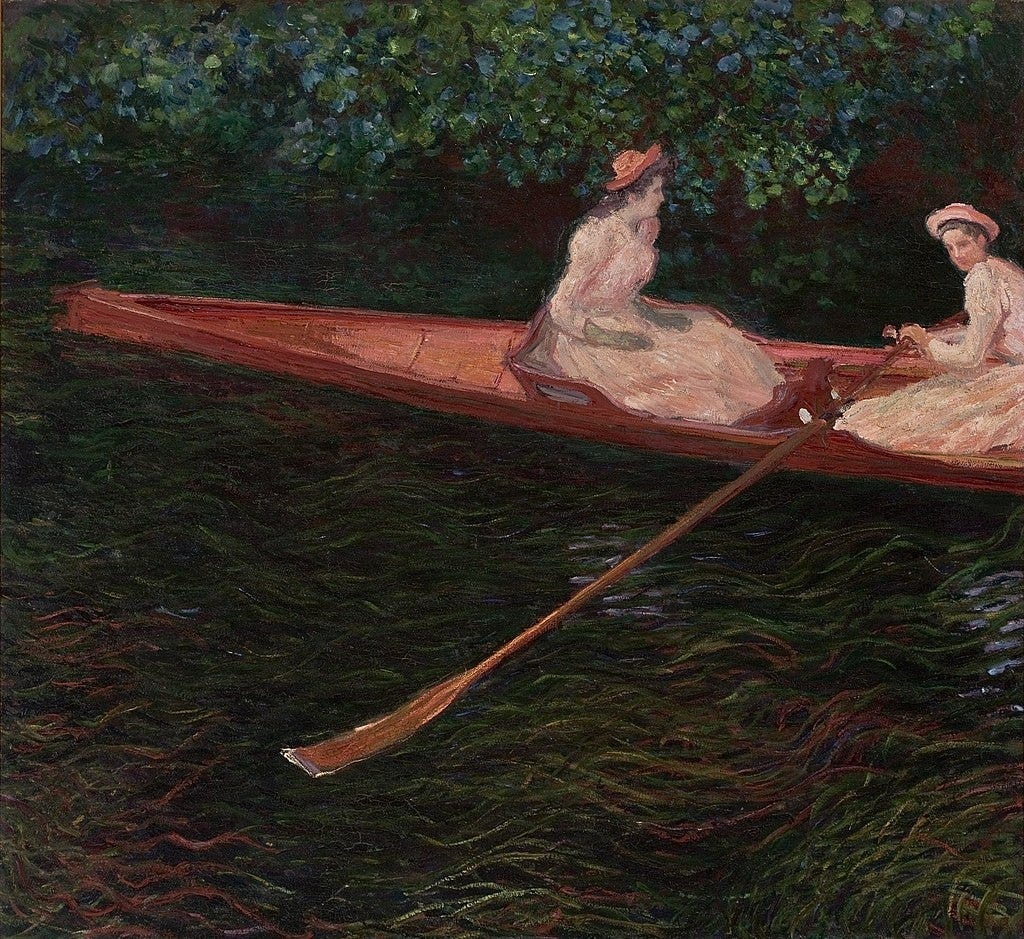
“Notice the lines in the water—”
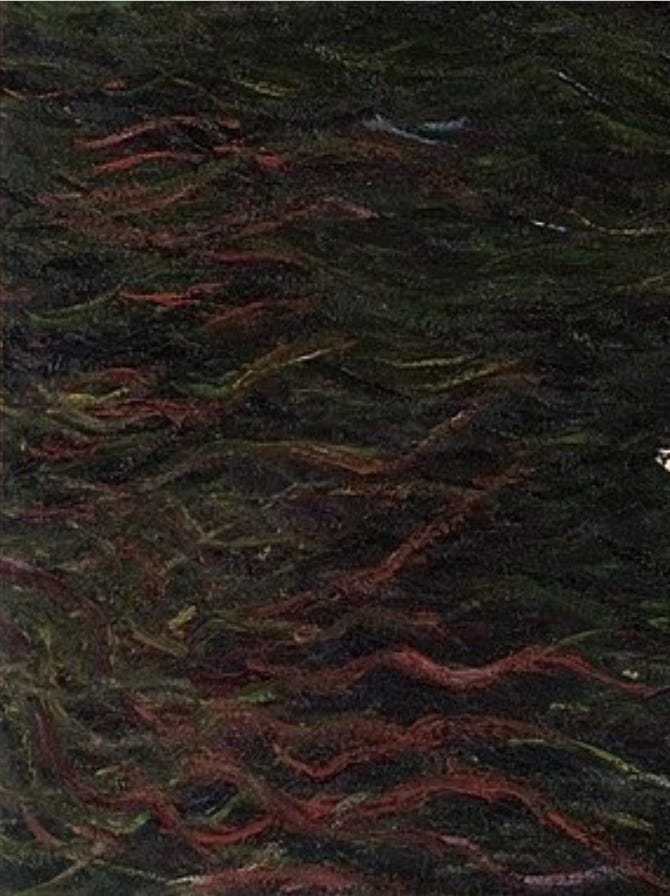
“—and how they echo the of color of the boat—”
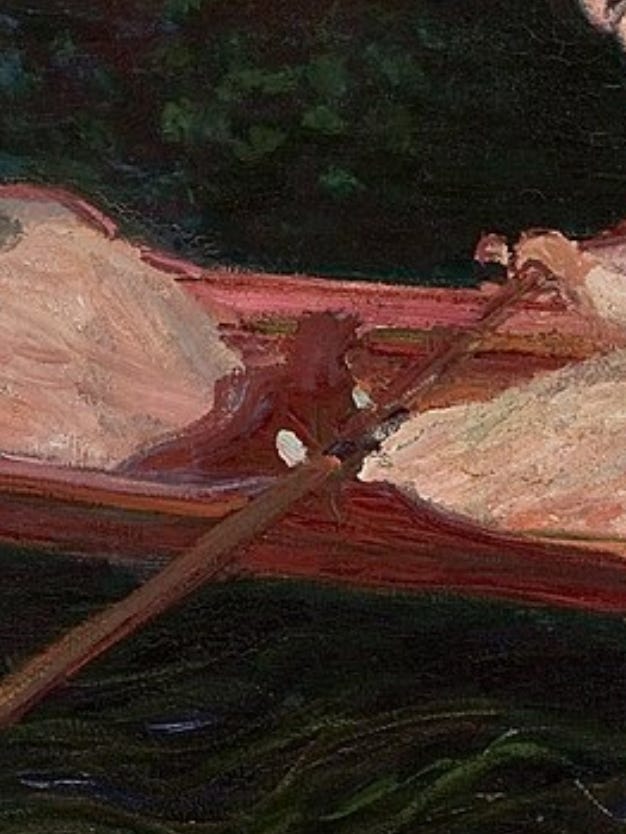
“Can you feel how that helps tie the picture together and adds to the wholeness?”
The longer I looked at the world as seen by Johanna, the more I seeped into my eyes. The more I nurtured her to go out and explore things I wouldn’t care to explore, the wider my experience of reality became. We started working much more closely together again, writing essays, digging stones out of the ground to prepare the garden, and talking late into the night as the children slept.
Walking out of the house after one of our sessions looking at Monet paintings, I turned left into the woods and followed a line that Johanna was turning into a path. It was twilight, in the part of summer when the sun barely sets around here. On the pines—these pines that I had been so tired of, so bored by—every needle shimmered, distinct. The red on their trunks was the red of Monet’s boat. It was almost hard to breathe from all of the detail I suddenly noticed, and the beauty of the details.
The moss on the ground was, I observed, made up of thousands of clear green stars of moss stems. I bent down. Among the green stars crawled red dots: clover mites, their eight legs almost pink, ending in minuscule claws which they used to navigate the intricate network of moss stems. One of the mites found a droplet and stuck its head into the water. Imagine being that mite, I thought: you find a perfectly round ball of water, larger than your head, and when you get thirsty, you sink into it.
This, to me, is one of the most profound rewards of love: that it can expand you so that more of the world becomes real to you. You can provide others with the love and care they need to transform and discover new aspects of themselves and of reality, and then, by meeting them where they are now, you can learn to see what they do, and so see further.
Which will change you.
And so change them again.
Dostoevsky as lover

This is the second part of a series that began with “Looking for Alice.” You don’t have to read that to understand this. But it’s cute. There is also a third part called “Relationships are coevolutionary loops.”
This is beautiful. Thank you.
So many things I find interesting, but I think the biggest one is how much *self* this form of loving takes. For both of you, finding common ground with which to discuss gardening required deep, deep knowledge of the way the other saw the world, as well as the ability to process how that interfaced with your own preexisting conceptions. It is a very admirable level of awareness, especially as you know you are both constantly changing.
It feels a bit daft to say, but love takes so, so much heart.
What I found most precise here is that love is not treated as the possession of a shared world, but as an apprenticeship in another person’s attention. There is something deeply demanding in that. To love someone who changes is not only to tolerate the change, or even to support it from the outside. It is to risk being changed by the new world that their attention has opened. In that sense, love is not merely fidelity to a person as they were, but fidelity to the reality that becomes visible through them.