


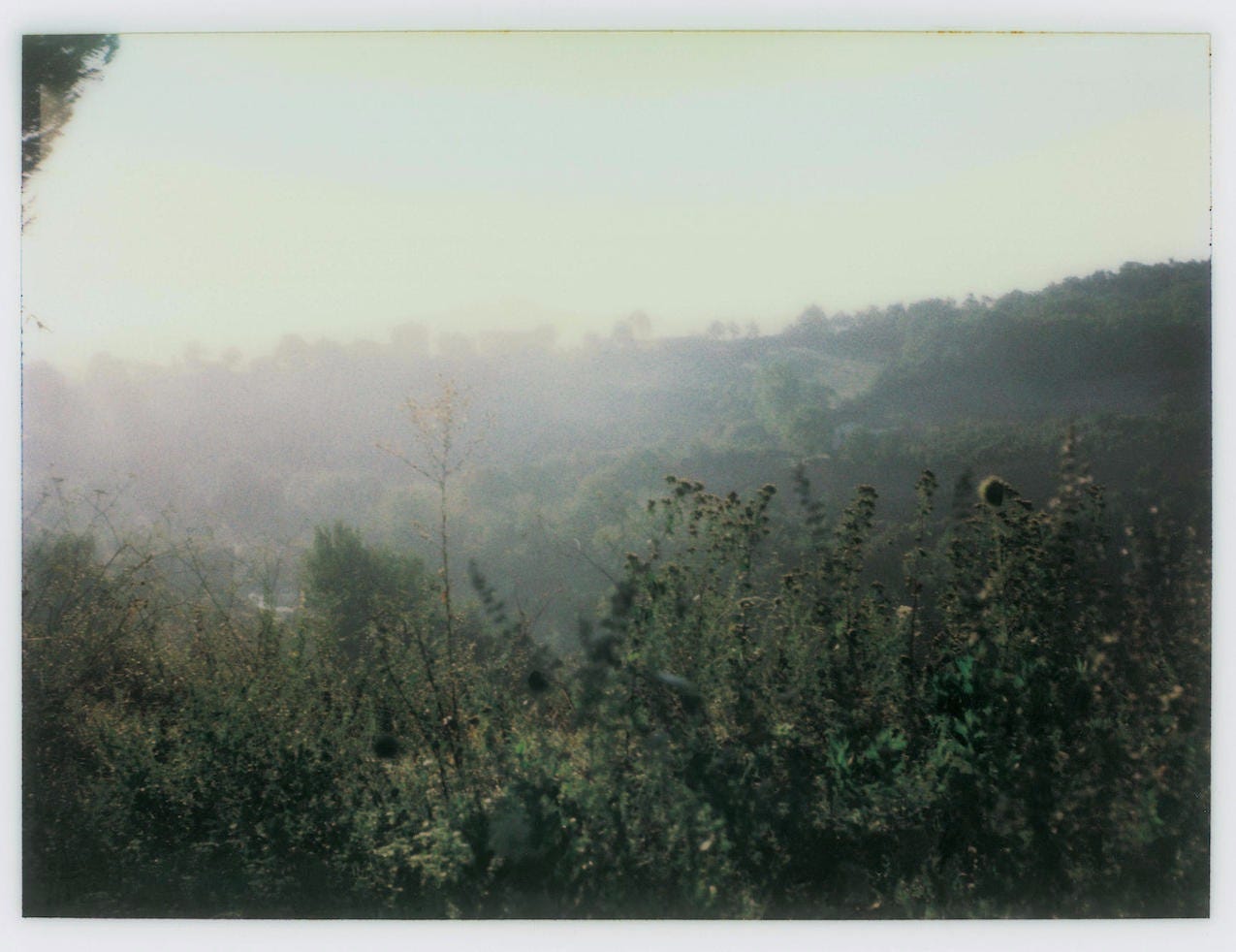
A polaroid by Andrei Tarkovsky
There’s this design heuristic that if people cut across the grass, you should pave the shortcut they make. This gives the path a lovely human fit. But sometimes you want to do the opposite. You want to design ways to get people to take a longer path, a longcut, so they can see or do things they’d miss otherwise.
Johanna and I are talking about this as we walk through the forest on our grounds, where she is scouting the path for a new walking trail.
“This hilly area here,” she says, “where it is just tree trunks and no undergrowth. The evening sun comes from behind here, so the trunks throw a stripe pattern of long shadows on the ground. And it's just stunning looking through the forest with these full-grown trees in the evening. But we never go here.”
She is trying to integrate the parts that we’re never visiting by making small interventions that slightly change their function; a path, a seating bench, a stair where it’s too steep. By leading us off the easy path—the one that leads to the garbage can and the mailbox—we can enable new activities. If we put a table at the end of this path, I can go out and work when I feel blocked in the office. There is that feeling of returning to the body which the forest enables, and which we can encourage by having dinner at the meadow where the last light sets in late summer.
Writing essays is a lot like this. I walk the landscape to find interesting and overlooked spots, and then I make a path there. The words you are reading right now are not the fastest way to get from A to B. Writing it, Johanna and I have not asked ourselves where people were already going so we could make that a little more convenient. Instead, we're trying to create a path to encourage you to walk in a direction you wouldn't otherwise because we think that it's going to be an interesting experience for you. Writing an essay is like saying, Oh, look at how beautiful the light is over in that clearing! And then you get there, and we say, Oh, there's a wild rose, a little further on. Keep walking. It will be worth it.
Shortcuts tend to be pragmatic and goal-directed; you cut across the grass to save ten seconds on your way to the library. Longcuts are more about enabling; opening up a space for activities.
After I wrote “Looking for Alice,” I received an email from someone who had read it and decided to break up with their partner. This was a startling thing to hear, that someone had walked into a series of thoughts I had written down and come away in that state. But a few weeks later it happened again: another breakup. And then I got an email from a couple who had been separated. They got back together after one of them emailed the essay to the other. This also happened twice. I hadn’t planned to alter the relationship status of strangers—I had just written some dating advice for my friend Steve Krouse (he’s off the market now). But in so doing, I had somehow constructed a path into a landscape of thought where things like this happen. The love story that “Looking for Alice” centers on created a narrative drive, a reason to walk out of your way, and pulled by that narrative these readers entered into a place where they saw their relationships in an unfamiliar light. An essay is not a vehicle of knowledge transmission; it is a landscape to think in, and a path to get there.
It is tempting to make shortcuts. When writing or doing art or building software (or in any other way constructing paths for people to walk on), you can typically earn more if you cater to the marginal user, the one who is on the fence. But the marginal user is the least patient and least interested, so you have to simplify, reduce friction, make the path direct and unambiguous—and you end up working for the shortcut paving company. Imagine if Newton, when he had trekked through the landscape of thought and found equations that could unite the heavens and earth, had said, “Yeah, but this is a little convoluted, I should cut that part. . .” No! We build paths. We look for better ways of expressing ideas. We find more effective methods of teaching. These days, millions of people are capable of walking into the region of thought where Newton saw the laws of motion. And we can put satellites in orbit.
Almost everything that is meaningful, beautiful, life-affirming, empowering, transformational, true—it can’t be reached by shortcuts. But what we can do is make the longcuts walkable, put out footbridges and stairs, and a table where the ocean comes into view.
Johanna ordered an art book with paintings by Monet the other week. We sat in bed looking at the pictures together. I do not typically spend a lot of time looking at pictures—that is not my flavor of patience. But I love seeing the world through Johanna’s eyes, so I suspended my impatience and let her show me a path into the images.

“Notice the lines in the water—”
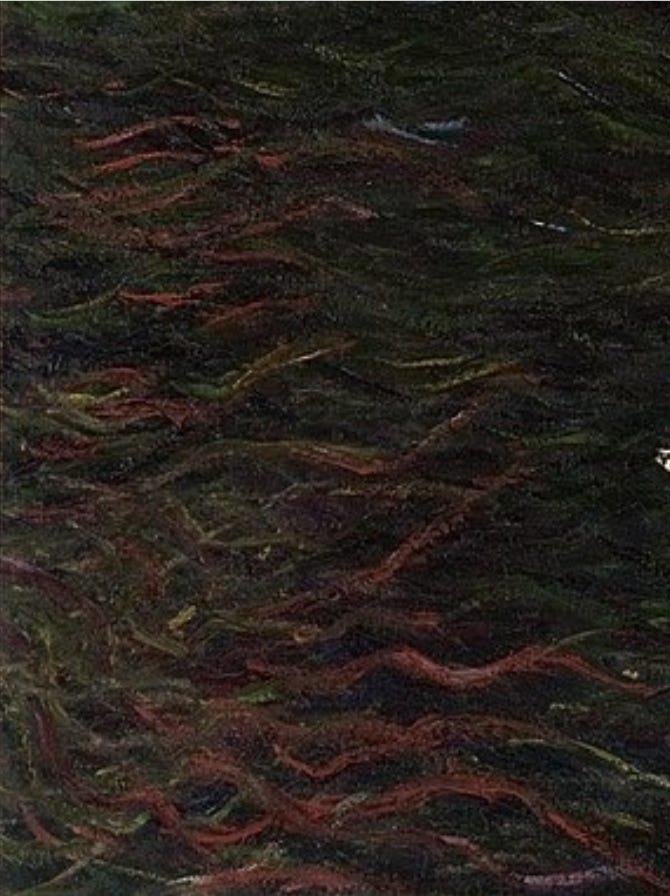
“—and how they the echo of color of the boat—”

“Can you feel how that helps tie the picture together and adds to the wholeness?”
The longer I looked at the world as seen by Monet, as seen by Johanna, the more I seeped into my eyes.
I took my jacket on. Walking out, I turned left and followed the line that Johanna intends to turn into a path. It was twilight. The shadows were, yes, long stripes on the forest floor. Every needle on the pines shimmered distinct, with a level of detail that I’m not used to. The moss, I noticed, was made up of thousands of clear green stars of moss stems. I bent down. Among the green stars crawled red dots—clover mites, their eight legs almost pink, ending in minuscule claws which they used to navigate the intricate network of moss stems. One of the mites found a droplet and stuck its head into water. Imagine being that mite: you find a perfectly round ball of water, larger than your head, and when you need to drink, you sink into it. I looked up at the stems of the trees rising toward the shifting sky, got to my feet, and continued down the path.
If you liked this essay, you might like another one about me and Johanna—on conversation, love, and craft:
Dostoevsky as lover

This is the second part of a series that began with “Looking for Alice.” You don’t have to read that to understand this. But it’s cute. There is also a third part called “Relationships are coevolutionary loops.” A summer ten years ago, I spent all day every day talking to Johanna.
Whenever someone talks or writes about building a path or a trail, it always reminds me of “The Calf-Path” poem by Sam Walter Foss, which goes like this (In case you have not read it):
One day, through the primeval wood,
A calf walked home, as good calves should;
But made a trail all bent askew,
A crooked trail as all calves do.
Since then two hundred years have fled,
And, I infer, the calf is dead.
But still he left behind his trail,
And thereby hangs my moral tale.
The trail was taken up next day
By a lone dog that passed that way;
And then a wise bell-wether sheep
Pursued the trail o’er vale and steep,
And drew the flock behind him, too,
As good bell-wethers always do.
And from that day, o’er hill and glade,
Through those old woods a path was made;
And many men wound in and out,
And dodged, and turned, and bent about
And uttered words of righteous wrath
Because ‘twas such a crooked path.
But still they followed -- do not laugh --
The first migrations of that calf,
And through this winding wood-way stalked,
Because he wobbled when he walked.
This forest path became a lane,
That bent, and turned, and turned again;
This crooked lane became a road,
Where many a poor horse with his load
Toiled on beneath the burning sun,
And traveled some three miles in one.
And thus a century and a half
They trod the footsteps of that calf.
The years passed on in swiftness fleet,
The road became a village street,
And this, before men were aware,
A city’s crowded thoroughfare;
And soon the central street was this
Of a renowned metropolis;
And men two centuries and a half
Trod in the footsteps of that calf.
Each day a hundred thousand rout
Followed the zigzag calf about;
And o’er his crooked journey went
The traffic of a continent.
A hundred thousand men were led
By one calf near three centuries dead.
They followed still his crooked way,
And lost one hundred years a day;
For thus such reverence is lent
To well-established precedent.
A moral lesson this might teach,
Were I ordained and called to preach;
For men are prone to go it blind
Along the calf-paths of the mind,
And work away from sun to sun
To do what other men have done.
They follow in the beaten track,
And out and in, and forth and back,
And still their devious course pursue,
To keep the path that others do.
But how the wise old wood-gods laugh,
Who saw the first primeval calf!
Ah! many things this tale might teach --
But I am not ordained to preach.
“An essay is not a vehicle of knowledge transmission; it is a landscape to think in, and a path to get there.” This sentence is gold. I so enjoy how your essays extend an invitation to think. I’ve come away from reading this one with an opinion that thinking is the greatest form of entertainment. I have a nickname: the Option Queen. There is nothing I like more than to think up as many different ways of answering questions as I possibly can. Now I can imagine doing so as cutting paths to connect all the various memories, knowledge, emotions, and sometimes detritus in my head, making me a more cohesive person … thinking then is the glue that holds me together and sticks on new and interesting parts.