


From Lessons in Darkness, Werner Herzog, 1992
I recently reread The Path to Power, the first part of the biography of President Lyndon Johnson, which Robert Caro has been working on since 1976. Before I first read Caro seven years ago, my understanding of how political power works was, as I recall it, very limited and flawed. I thought about power—to the extent I thought about it at all—in abstract and formal terms, along the lines of how it was explained in school. There were branches of government vested with different kinds of powers, and rules and laws governing how they can be used and by whom. If you got elected to a public office, you gained power; if you got a job as CEO, you gained another sort of power, and so on.
In Caro’s biographies, it is clear that the real political operators don’t think about it like this at all. To them, power is something you frack, something you force out of the stone by pumping fluid into the cracks. If you pay close attention, you will discover that there are drops of power everywhere—in the good feelings someone’s mother holds for you, in being able to get your college friend a job, in knowing embarrassing facts about your mentor, in having someone’s trust, and so on. To any normal person, these drops are so small that they barely register, and anyway, it feels wrong to treat someone’s mom as a reservoir to frack. But Caro’s subjects are willing to do anything to win, so they will, so to speak, pump fracking fluid into the ground. They will press it into every little crevice, forcing drops of power mixed with sand to the surface. And as it turns out, if you extract all the small things and pool them together, it can be a massive reserve of power, indeed.
It is not that the political “technicians” don’t care about the official sources of power—Lyndon B. Johnson is willing to do anything to become president, however appalling and degrading to himself or others. But a presidency, or a senate seat, or a seat in congress—that is like a big, well surveyed oil field. It will be intensely competed over, unlike the smaller crevices of power. And unless you have been able to frack enormous amounts, being elected to office is of limited use. Kennedy, for instance, struggled to push his programs and reforms through Congress, but the week after he was assassinated, the very next week, the reforms got unstuck and started moving, as Johnson was sworn in.
It seems Johnson saw the entire world in terms of instruments of power that he could collect. This is the purpose of life as far as he’s concerned. It seems to have been this way since he was a toddler. Age three, when he can’t get attention, he hides inside a haystack and listens for a long time as his father’s workers search the hills and the creek. His mother stands a few feet away from him, crying; he doesn’t let her know; he seems to enjoy being able to control what other people feel and do.

As a teenager, when he meets his friends’s parents and grandparents, he flatters them endlessly, climbing into the knees of harsh old women to kiss them and call them grandma. When his friends want permission to do something they know their parents will not let them, they send Johnson instead, because the adults are so enamored by him that he can get whatever he wants. His flattery gives him power over the parents, which gives him power over the children.
Since he sees the world always in terms of tools that let him bend people to his will, Johnson becomes a true connoisseur of leverage. He notices potential sources of power in places where I’d never think there was any. For example, he seems to realize, sometime in his twenties, that knowing how to get someone else a job gives you purchase over them. So, while still working as a teacher, he begins collecting jobs. When he quits a position, he does it in such a way that he can pass the job on to one of his friends. And when they quit, he makes sure the job goes to another person he wants to control—often by orchestrating so that the person who has the job quits at the worst possible moment for the employer, and the person Johnson wants to get the job comes in the same day with their CV and explains how they can take over and solve the problem.
It would never occur to me to treat jobs this way. But done over and over again, collecting more and more jobs, these odd maneuvers become a source of genuine political power for Johnson. When he is 27 and sees a chance to get elected to Congress, he has about a dozen friends placed at various workplaces, and as soon as the signal comes, they throw themselves into their cars and drive to Austin to help Johnson get elected (with the understanding that this will lead to him being able to give them even better work). By collecting jobs, Johnson had created a political organization for himself, a cadre of men who would do his bidding no matter what he asked, a forceful instrument of power. This, then, allows him to get elected to Congress—which naturally leads him to acquire even more tools: money, contracts, mentors, favors, scores of jobs to distribute among his allies.
The more power he manages to collect, the greater his capacity to acquire more, in a rapidly escalating loop. Four years after spending his time coordinating his friends so they can keep various teaching and administrator jobs within his circle, Johnson has managed to compound that small deposit of power into near-free access to the back door of the Oval Office and the president’s ear.
Let me linger on the oddness of seeing a source of power in manipulating the principal at a school to pass a job on to one’s friend. It’s striking that the best players, those Caro focuses on, almost always seek out such unexpected sources.
Robert Moses, the Planning Commissioner, Building Coordinator, and Parks Commissioner of New York, and the subject of Robert Caro’s first book, is a good example.
During the years between 1934 and 1968, when Robert Moses had almost free rein to shape New York as he pleased, the root of his power was so-called public authorities. (To explain what a public authority is: sometimes when you build, say, a bridge, politicians will decide that part of the cost should be covered by the bridge itself by taking out a loan and setting up toll booths to pay it off. The money collected then goes to a public authority that is created for that bridge, and when the loan for the bridge has been paid off, the public authority is dissolved or turned into a vehicle for maintenance.)
Before Moses, no one had understood that public authorities could be a way to power—until this point, public works had been small projects, and public authorities seemed boring and inconsequential. But what Moses realized was that he could use part of the revenues from a public authority for other projects, and in that way the original debt would never be paid off… which meant the public authority could exist indefinitely and generate a steady income stream that its chairman could control. Also, since no one had thought that public authorities could be used this way, no one noticed the implications of certain formulations Moses snuck in when he wrote a new state law regulating public authorities, formulations which in practice made it nearly impossible to fire Moses from the chairmanships he began securing for himself.
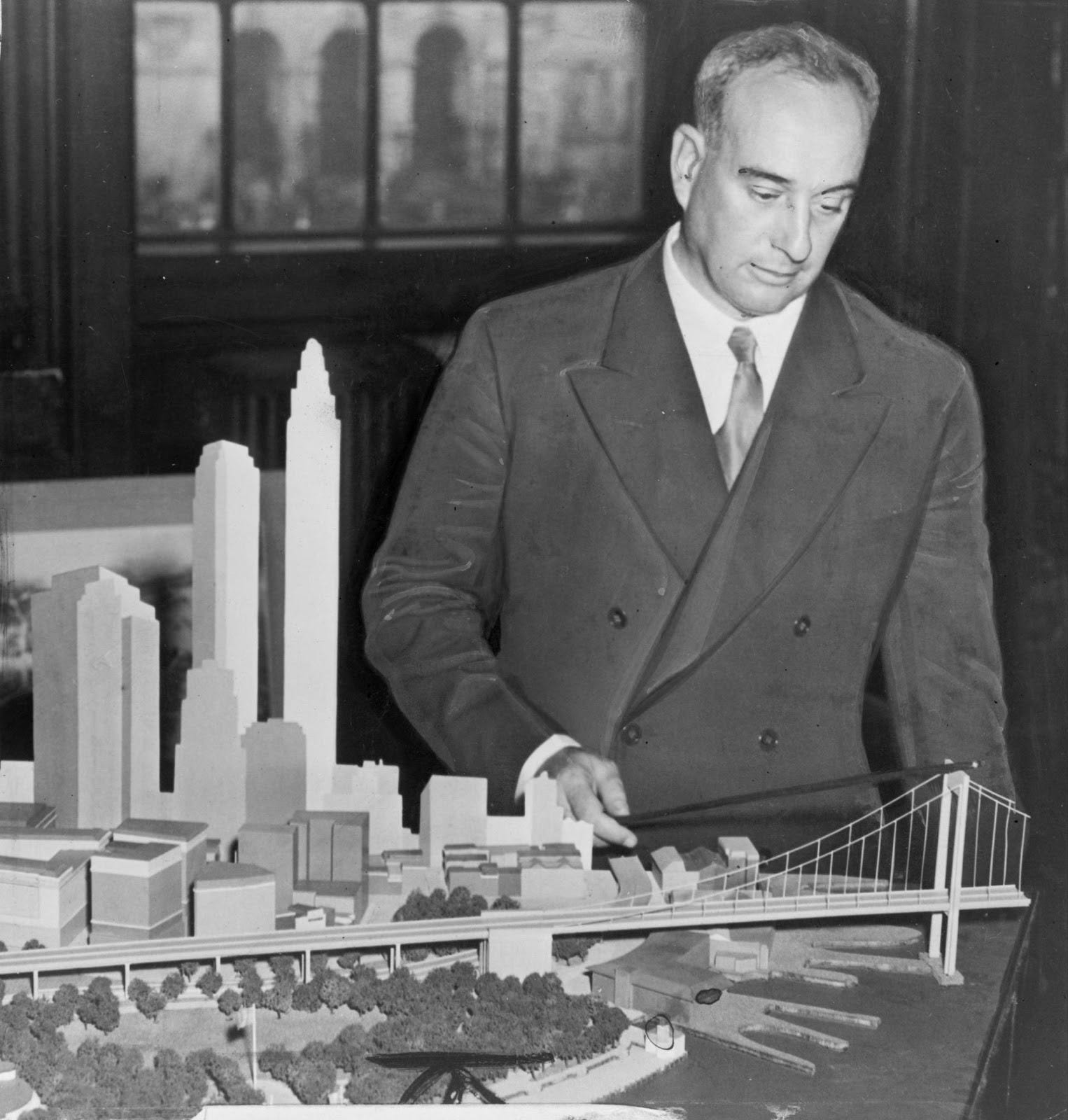
In this way, Moses, a public employee who never held an elected office, became something bordering on a dictator, with full control over public authorities generating $2 billion a year (inflation adjusted to 2026 dollars), an empire which he used to sculpt New York as if it were his private art project.
There’s an element of hacker mindset in interacting with the world this way.1 Both Johnson and Moses took seemingly irrelevant details of reality and leveraged them to get results that seem unbelievable (and/or appalling) to others. It is like when people do speed runs of video games: it feels like they are playing a completely different game. Speedrunners don’t think of the games the way normal players do—they don’t think in terms of “walls” and “doors” and “levels” and “weapons” and so on; they think in terms of the structure of the underlying software that is generating this, and the hardware that the code is running on. The game for them is about figuring out how to push the controller in such a way so as to cause the underlying code and hardware to behave in unintended ways, causing “bugs” that will let them jump through walls or travel straight to the last level, and so on. Speed runners are looking at reality at a different level of abstraction and can, because of this, do things that seem impossible at a more superficial level of abstraction.
When you treat power in the same way, as Johnson did, it has very strange and unpredictable consequences for the fabric of a society. It is like being in a game where someone else is speedrunning, pushing the game engine to glitch in ways suitable for them: you, as a normal person, will be going about your days, but there will be these odd, seemingly unconnected bugs happening—the world around you will be changing in strange ways—and then suddenly, someone has teleported to the last level and gained enormous power. And perhaps is using it in disturbing ways.
Here is one way to think about what is going on. Normal people care about a lot of things. We want to have a good time and fit in and be ethical and have status and so on—it is a very complex sort of value function. And since it contains many competing considerations, none of the dimensions we care about get particularly optimized. We have an ok time, but not a great one, and we’re decently ethical, but not as good as we’d like to be, and we have some power over our lives, but not as much as would be ideal.
But someone like Johnson only cared about power, so he is able to optimize that much harder. When Johnson looked at a job, which to us is a complex bundle of “a role in the community, a source of income, some status, something to do with our time, and, yes, some limited power”—Johnson saw only power. Therefore he treated the job only as a way to acquire leverage, which is very different from how a normal person would treat a job. And because he optimized so hard along this vector, he got to be very effective at it.
But it also had a lot of unintended and unpredictable effects for other people and the aspects of the world he didn’t care about.
To take a contemporary example: most people like it when others pay attention to what they do. But it is not, or at least wasn’t until recently, something that most people optimized for. Rather, attention was a part of a complex web of social values. We received attention in interactions with people we cared about and had a relationship with, and as much as we enjoyed when people gave us attention, it was weighed against all sorts of other considerations that were at play in the lifeworld where it occurred.
But then social media companies realized that fleeting acts of attention were something that could be isolated from this rich weave and fracked and pooled together into a source of considerable power and wealth. They did not care about the complex lifeworld where the attention was situated; they were willing to optimize for attention capture irrespective of how altering that dimension of social reality altered other dimensions. These companies: 1) got very, very good at it, 2) without the users fully realizing how their lived environment was getting restructured to frack more of their attention, and 3) in the process, endless, unpredictable changes occurred along the other dimensions that the companies weren’t optimizing for. The attempt to capture and control attention changed how communities form; it changed people’s dating lives; it spawned new ideologies; it undermined the trust that had held society together, and so on.
You see something similar with Johnson. He saw power where people had previously seen none (or where people had sensed a tiny, inconsequential sliver of influence mixed in with a hundred other things, like oil in sand), and then he optimized ruthlessly along that dimension. But since the power he extracted was bundled with and connected to all sorts of other things, his actions reshaped not only the distribution of power, but the very nature of our societies. Johnson vastly increased the level of spending on political campaigns in the US and established the pipelines that led East Texas oil money into DC, with everything that followed from that. He precipitated the collapse of trust in government. And so on.
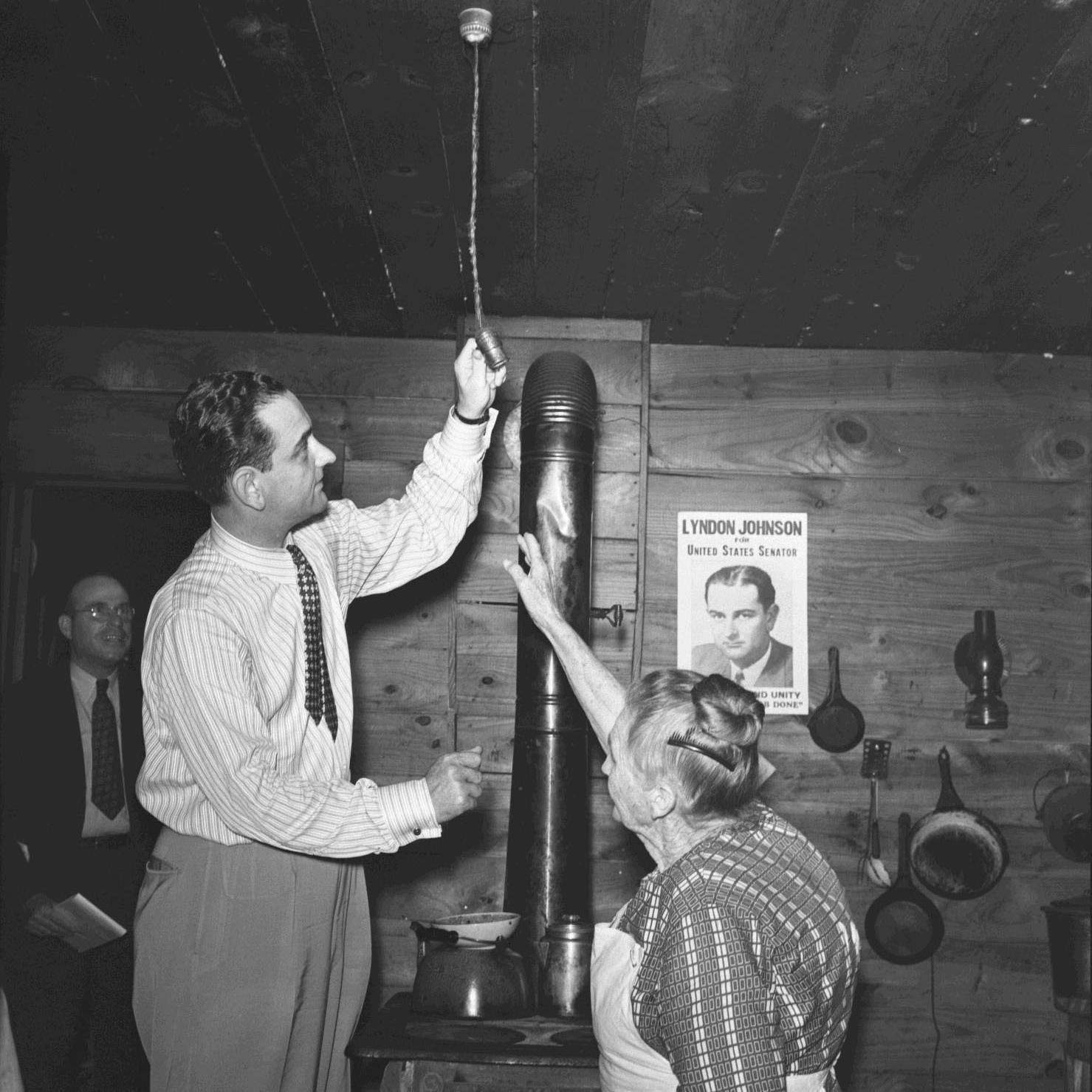
It wasn’t like everything else, everything he didn’t care about, got worse. Sometimes, it got a lot better (as when Johnson pushed through rural electrification, with genuine eagerness, improving the lives of thousands of people, since it aligned with his amassing power). But when that alignment broke, Johnson, just as eagerly, destroyed the lives of people. Before he was forced out as a president, his exponential accumulation of power had led to the killing of more than a million people.2
The sanitized view of power and institutions that I was taught in school is misleading and provides a cover behind which political operators can hide. For similar reasons, conspiracy theories of evil elites are also problematic.
What is needed is an understanding of the real game of power, the kind that Caro provides. It makes us less naive about how things get done, and it gives us a better understanding of the value of democracy. The official story about the expression of the collective will and so on is largely a fiction, but the institutions and rules still matter a lot: as a check on the runaway loops of power grabbing that people like Moses and Johnson engage in.
This essay was written in conversation with Johanna Karlsson. The copy edits were done by Esha Rana.
Repeat great words, repeat them stubbornly

There are certain works—paintings, films, books, gardens—that have an effect on me that I can most simply describe by saying: in their presence, I remember that I am a human being. In this series, I write about these works.
‘hacker mindset’ is, fundamentally, a sort of reductionism run amok, where one ‘sees through’ abstractions to a manipulable reality. Like Neo in the Matrix—a deeply cliche analogy for hacking, but cliche because it resonates—one achieves enlightenment by seeing through the surface illusions of objects and can now see the endless lines of green code which make up the Matrix, and vice-versa. (It’s maps all the way down!)
In each case, the fundamental principle is that the hacker asks: “here I have a system W, which pretends to be made out of a few Xs; however, it is really made out of many Y, which form an entirely different system, Z; I will now proceed to ignore the X and understand how Z works, so I may use the Y to thereby change W however I like”.
Mainly, Vietnamese.
I surprisingly thought a lot about the nature of power at my last job as an integration engineer, where my role involved making design decisions that impacted multiple groups. It was tricky because individual decisions usually negatively impacted specific groups, even if it’s the best decision overall. I had to build a lot of trust with people to get buy-in. In practice, this meant being transparent, getting input from stakeholders, being intentional with when I made a decision vs deferred to someone else, and trying my hardest to act based on technical integrity, not office politics. It was a slow, distributed way of gaining influence, but over time it was powerful and effective to get people to collaborate and reach consensus. But what threw me were a few coworkers who practiced the opposite, but somehow still zoomed to positions of authority above me, where their actions had negative impacts across the company. I wasn’t sure if that reflected something fundamental about the nature of power, or just the systems in place at that particular company. I even wondered if cultural influences were at play— I was the only East Asian person making that level of inter-system architectural decisions, and most of the people with more technical authority than me were white men. Like am I reading these descriptions of LBJ’s approach to power, relating it to old coworkers, and getting the ick because the ghost of Confucius lives on in me? Lol. It makes me curious how power systems work in cultural contexts outside the U.S.
I continue to be shocked how much the Discworld books I read as a kid taught me.
In the Academy, there was a young man named Ponder Stibbons. He was the lowest status wizard. Because he was the lowest status wizard, he got handed responsibility over all sorts of unglamorous things. He kept saying yes to all of them. By the end of the series, he was *the most* influential and powerful wizard in the academy. All the small things he held responsibility over added up to being big things (you got a vote for each position you held, and over time he amassed enough positions to hold a majority vote on his own. It's summarised in his wiki pages, if you understandably haven't read the books but are curious about the broad strokes: https://discworld.fandom.com/wiki/Ponder_Stibbons)
And I remembered this lesson from the books, as a kid. Funnily enough, Ponder also developed the first in-universe computer. He *was* a hacker.
I'm feeling emotions about all the wisdom Pratchett snuck into these books that read as silly on casual glance. And how well they've aged, and how relevant they still are.