

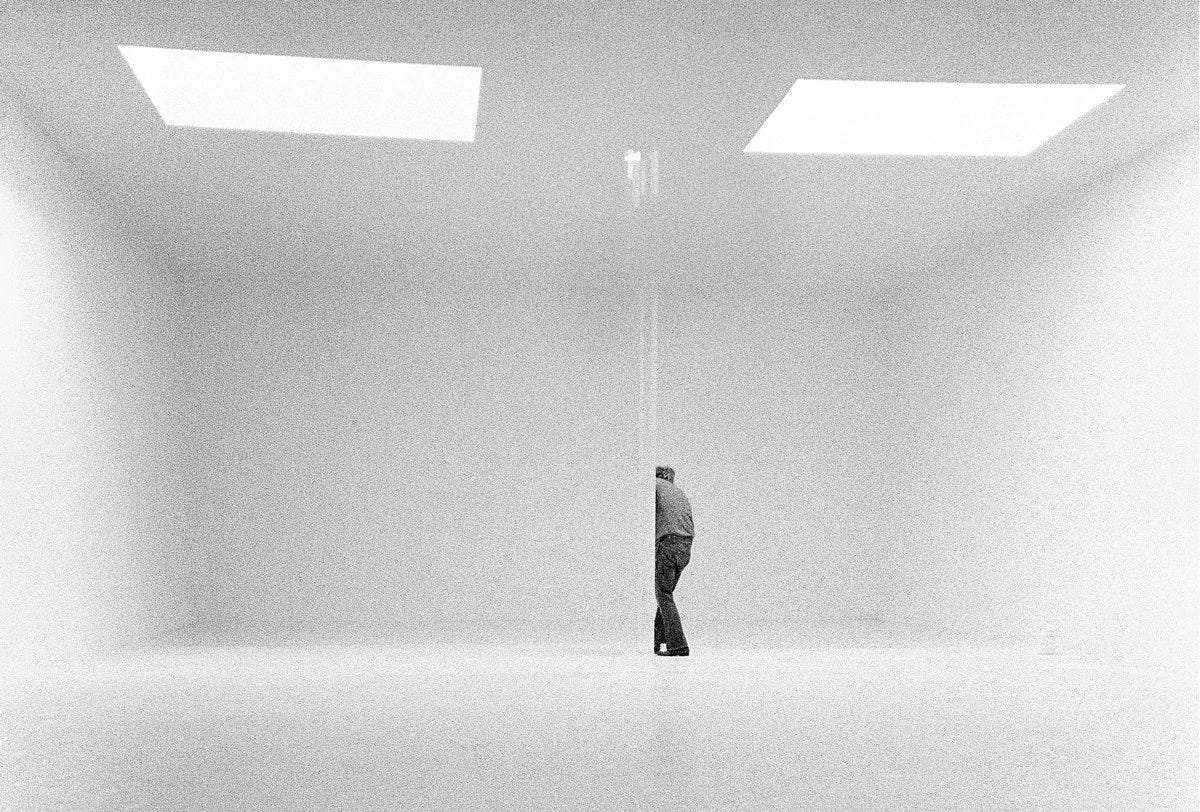
Robert Irwin in his Venice, California studio in 1970, photographed by Steve Kahn
When I have a problem, Johanna—a.k.a. my wife—typically solves it by asking me one of four questions.
1. Why does it feel bad?
If something feels bad, it is useful to articulate very precisely why it feels bad. This helps extract a lot of valuable information.
For instance, I was vaguely unhappy with an essay draft I finished today. It just felt ugh. But when I complained to Johanna and she said, “Well, why does it feel bad?” it became obvious to me that the problem was the ending. It is hard to do endings well—they often feel like tying a ribbon on the whole thing; it’s too cute. And this one was a bit like that.
“How do you like endings to be?”
“I like it when you feel like you are approaching the end, so it’s not abrupt, but at the same time, the ending sort of turns things around. Or maybe more like the essay is a ski ramp, and when you get to the end, you are flung into the air.”
Johanna said: “Well, then you can just rearrange the points you’re making and put that twist you made earlier in the piece at the end instead, can’t you?”
And that worked.
It is often quite obvious what the solution is if you just articulate precisely what is wrong with the current one.
2. What is it you are trying to achieve here?
The first idea you stumble upon is rarely the best way of going about what you want to do. But it is very easy to become overly attached to it and limit your search so that you never find the better path.
This would happen all the time at the art gallery where I used to work. One of the board members would have an idea for a project and then—for no other reason than that it had been proposed—people would anchor on that and discuss various ways of doing it. “But what is our goal here, really? And is this project actually the best way of achieving that end?”
Articulating the goal, and keeping it top of mind, makes it much easier to evaluate the options and keep yourself from drifting. As Richard Hamming writes in The Art of Science and Engineering:
It is well known the drunken sailor who staggers to the left or right with n independent random steps will, on the average, end up about √n steps from the origin. But if there is a pretty girl in one direction, then his steps will tend to go in that direction and he will go a distance proportional to n. In a lifetime of many, many independent choices, small and large, a career with a vision will get you a distance proportional to n, while no vision will get you only the distance √n. In a sense, the main difference between those who go far and those who do not is some people have a vision and the others do not and therefore can only react to the current events as they happen.
I don’t interpret the word vision too strictly here.1 Sometimes a vision is a very concrete measurable goal (at the art gallery, for example, the goal was to double revenue while improving the quality of the exhibitions and keeping costs static), but often in life, I find it more useful to think in terms of “values” or “direction.” When I’m writing, I don’t have a goal; I don’t know where I’m going. I’m unfolding, following my curiosity. Still, I find it very useful when Johanna asks me, “So what are you trying to achieve here?”
Grappling with that question helps me articulate my values and problems and needs, the bigger picture of what I’m trying to do. And when I have that top of mind, it is easier to see if a project I’m working on is aligned with my value hierarchy, and/or if there is some version of it that would more ambitiously pursue what I’m after.
3. What are the alternatives?
When I have figured out what I want (or need) to do, Johanna will often ask me, “So what are the alternatives?” I like to pace the room and write down as many alternatives as I can come up with in five minutes, or twenty—or more if it is an important problem. This, too, is a way of fighting the tendency to settle for the first idea that comes to mind.
I’ll write down every idea I have, and then I’ll come up with prompts to make myself come up with even more. “If I had to reach this goal not in two years but two months, what would I do then?” “And if I got Werner Herzog to narrate—how would I want him to express these ideas?” I let every stupid- and impossible-seeming idea in; there is no bouncer at this club. I just keep pouring and pouring until I break out of my defaults and get creative.
I make lists like this all the time: when trying to figure out what to do with the kids, when deciding what essay to write, when deciding how to open the essay, when deciding the title, when weighing options for where to take my “career,” when coming up with things I want to talk about with my friends, and so on and so forth.
The best idea is almost never one of the first ideas I write down. There are better alternatives.
4. What would make the biggest difference?
This final question Johanna likes to ask has to do with opportunity cost. We will always have more problems than we have time and resources to solve. There is no way around it. We are going to have to leave a lot of important things undone. The only choice we have is whether we decide which projects are left undone, by figuring out our priorities, or leave that to chance, by sacrificing whatever projects are unfinished when time and resources dry up.
So—of the problems we can solve, which would have the biggest impact?
Sometimes you can answer this question by “finding the bottleneck.” A bottleneck, in manufacturing, is the part of the process that moves slowest and so sets the speed of the whole assembly line. There is no point in improving the process anywhere else because it will only lead to queues at the bottleneck. There is no point for me to get better at drafting essays—I can already hammer out something like a thousand words an hour. The problem is upstream of that, and a better problem to think about for me would be, “How can I have more ideas and experiences worth writing about in the first place?”
Other times, finding what makes the biggest impact is more a question of “what improves the wholeness.” What could I change that would make everything else better? For example: if you are making a garden, you can ask yourself what you could plant that would make the landscape come alive and vibrate with more beauty. It is easy to fall in love with a specific plant when you’re at the nursery and then just plop it down. But is it the plant that will make the biggest difference for the landscape?
Of all the things I can work on and improve in my life, what would make everything else come alive more?
Of all the things I could add to or remove from this essay, what would strengthen it most?
When you write a list post on Substack, people seem to like it if there are 20, 30, 50 bullet points. But I find these questions so useful that I won’t dilute them by adding more.
Why does it feel bad?
What is it you are trying to achieve?
Can you list some alternatives?
What would make the biggest difference?
Those of you who are familiar with my work might notice that this contradicts the point I make in one of my most read essays, namely, that the best things in my life have tended to come from unfolding, following the path of maximum interestingness, rather than pursuing a long-term goal. But the fail mode I was trying to warn against in that essay wasn’t having a goal in the vague sense Hamming gestures at here—a sense of direction, a sense for what is worth pursuing. I think that is very useful to have. What I find will mess things up for me is when I assume I know how to achieve that—what the solution will look like. I find it useful to have a sense of direction but remain agnostic and open-minded about which specific steps to take to get there—the drunk sailor will, after all, stumble upon tables he needs to get around, so he can’t be too attached to any specific plan. But a sense of direction helps, if you hold it lightly.
I'd add that the bottleneck moves once you fix it. Say you find a way to have more ideas worth writing about. Then the endings from your first question might become the slow part that sets the pace. So question four is worth asking again every few months.
I think they are excellent and concise questions, although I would go for 3, for the very scientific reason that I like 3’s !
I would probably drop question # 4, mostly because it’s almost impossible to know the answer to that in many cases.
You may only know what will make the biggest difference with a change of situation, circumstance or perspective.
I really liked this article.
Great questions and lots of food for thought ( although I’m not sure I need that ! )