

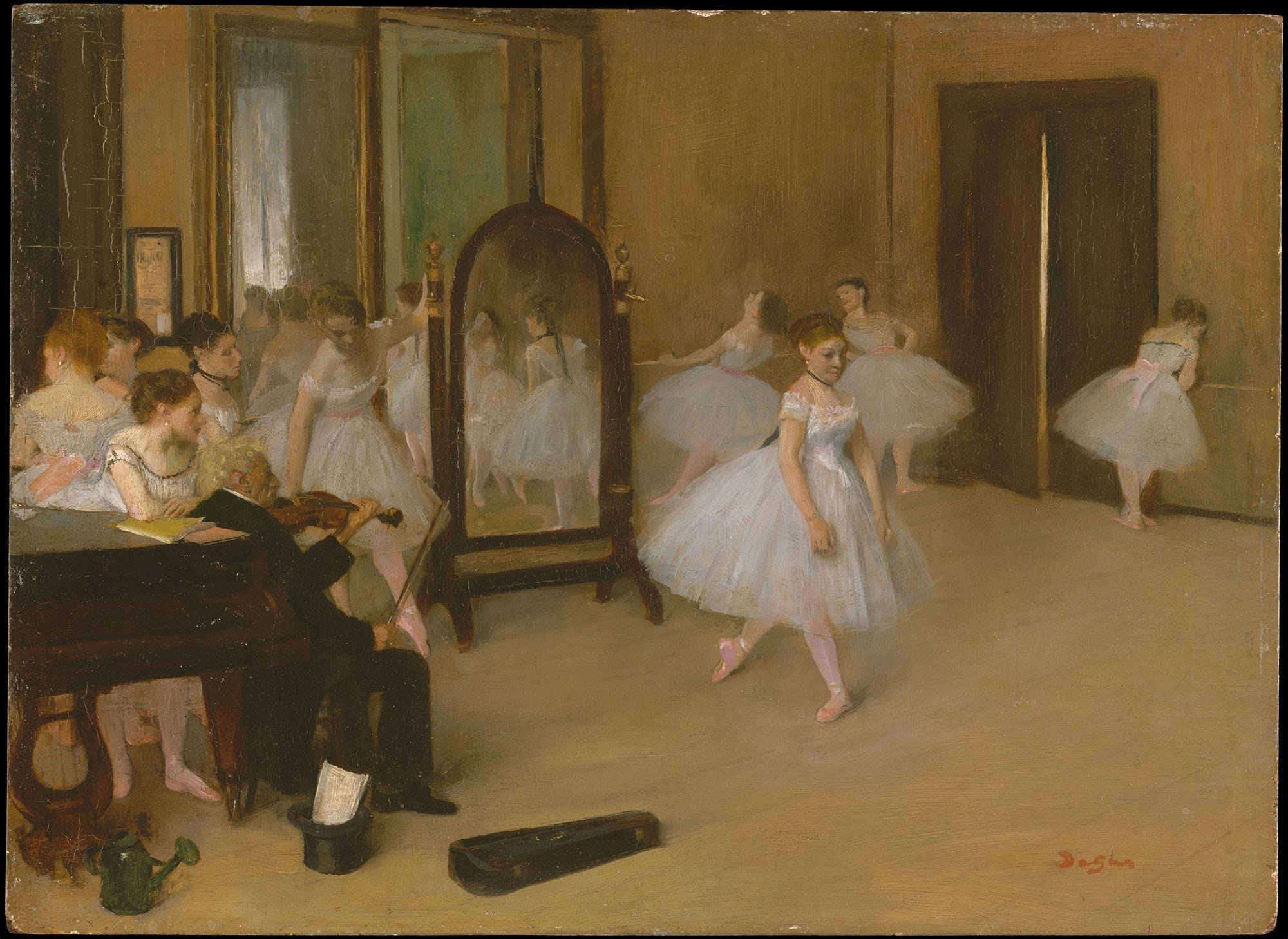
The Dancing Class, Edgar Degas, 1871-72
Here are some notes about something I’m trying to get my head around. I would appreciate feedback and reflections!
At the end are some recommendations of films and books I’ve found interesting lately.
In Récoltes et Semailles there is a famous passage where the mathematician Alexander Grothendieck writes about the years he spent as a young man isolated from the mathematical world, and how the experience of solitude was the key to his creativity.
Because of the Second World War, which Grothendieck partly had to spend in the internment camp at Rieucros, by 1945, as a seventeen-year-old, he was almost entirely self-taught as a mathematician. Too poor to get into a good school, he spent three years as a student in Montpellier, where the teaching was inadequate for his capacity, and where he therefore almost entirely avoided the lectures to instead pursue his own questions (and pick oranges to pay for his rent).
Three years later, when Grothendieck arrived in Paris to study at the École Normale, the French elite school for the country’s most gifted students, it became obvious how far behind his new classmates he was; they had spent their childhoods in private schools and with tutors.
Grothendieck writes that,
I admired the facility with which they picked up, as if at play, new ideas, juggling them as if familiar with them from the cradle—while for myself I felt clumsy, even oafish, wandering painfully up an arduous track, like a dumb ox faced with an amorphous mountain of things that I had to learn (so I was assured), things I felt incapable of understanding the essentials or following through to the end.
While the other students had been attending lectures, Grothendieck had, among other things, spent his time being confused by what length is. None of his teachers had been able to give him a satisfactory answer—they thought it was obvious what length was. His new teachers also brushed away what he had spent his teenage years on—the insights about length he had arrived at had already been known for thirty years as the Lebesgue integral! In the eyes of the faculty in Paris, his effort had been wasted.
But in Grothendieck’s eyes it had “not been wasted in the least.” In his eyes it was precisely that solitary work, when he had reinvented what a more competent teacher could have taught him—it was that work that allowed him, over the course of the next thirty years, to leave a mark on the history of mathematics, while his more competent classmates failed to do so.
Grothendieck, again:
In those critical years I learned how to be alone. [But even] this formulation doesn’t really capture my meaning. I didn’t, in any literal sense learn to be alone, for the simple reason that this knowledge had never been unlearned during my childhood. It is a basic capacity in all of us from the day of our birth. However these three years of work in isolation [1945–1948], when I was thrown onto my own resources, following guidelines which I myself had spontaneously invented, instilled in me a strong degree of confidence, unassuming yet enduring, in my ability to do mathematics, which owes nothing to any consensus or to the fashions which pass as law....
That is to say, the work in solitude had trained his ability to autonomously navigate to interesting and valuable problems—an ability that is crucial for navigating skillfully at the frontier of human knowledge and expanding what we know. (I also suspect that Grothendieck underrates how much more naturally gifted he was than his peers.)
(Johanna and I have written about Grothendieck in more detail here.)
One way to think about what happened during those years of solitude was that what Grothendieck developed was mental proprioception.
Proprioception (without the adjective mental in front of it) is our ability to, without the help of sight, determine how our limbs are positioned. It is a kind of three-dimensional sense for our body.
Ballet dancers have extremely good proprioception. In fact, a large part of the challenge in becoming a skilled dancer is precisely that kind of feel for the position of the limbs: it is at least as important as having the muscles required to execute the movements. A large share of ballet training is devoted to developing proprioception. You stand in front of a mirror and execute movements while observing what you are doing, so that you can more accurately correlate the shape of a good movement with how it feels in the body when it is performed. When the dancers have a deep, precise understanding of how it should feel when the back is straight in the right way, and the ankle bent correctly, and the leg lifted just so … then they can, during the performance, follow their feeling and know that the form is correct, and they can notice precisely what is wrong when they deviate.
The thought I am playing with is that the same is true for our thoughts: it is possible to have a better or worse sense for how our thoughts flow around in our heads. And it is possible to train your mental proprioception so that you can feel when your state of mind has the right shape for generating valuable thoughts and solving the problems in front of you, or when your mental posture is wrong.