

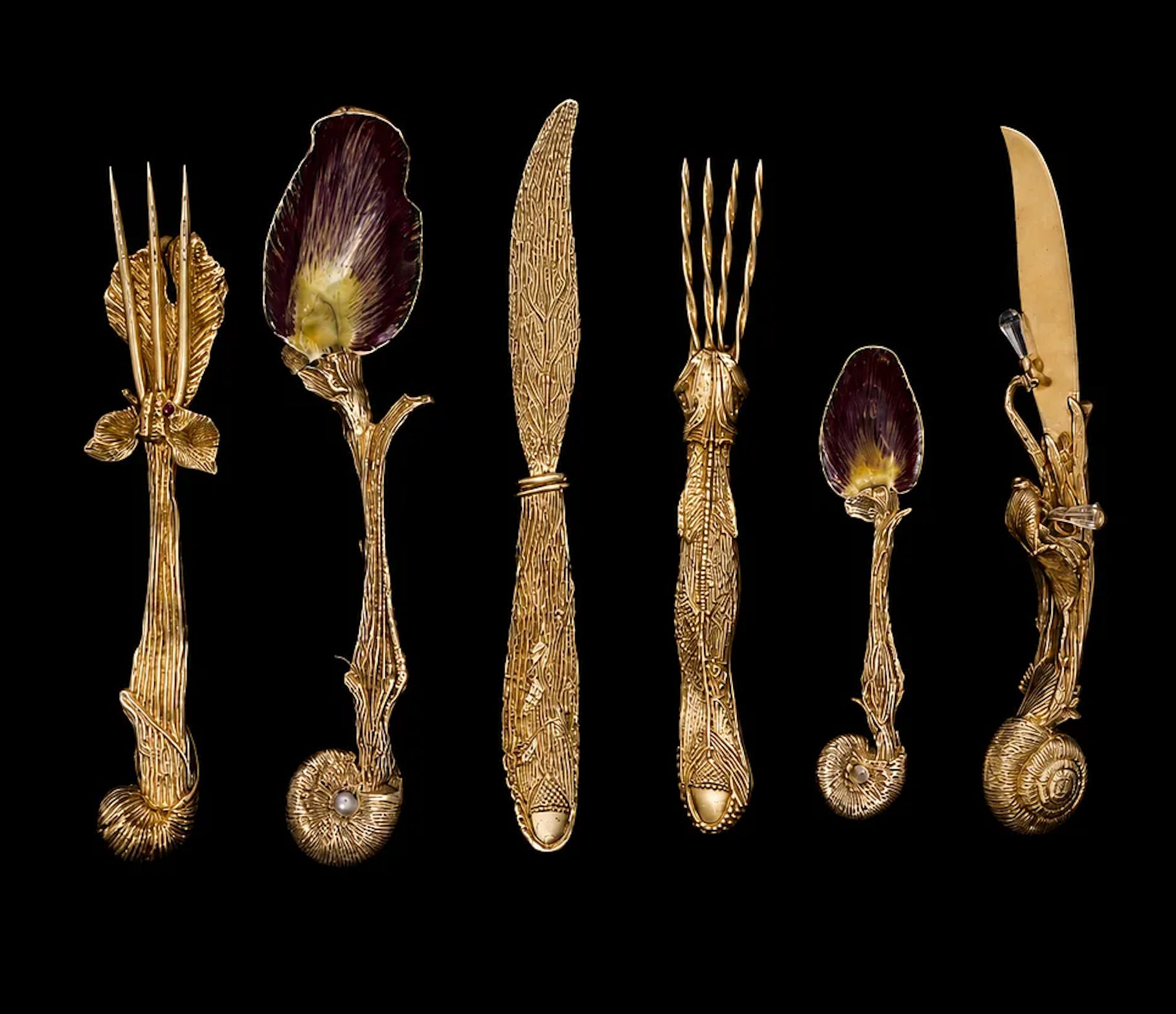
Cutlery designed by Salvador Dalí
I wrote some thoughts about how to have more interesting ideas two years ago. Since then I have had the privilege of talking about the idea craft with several people who are better at it than I am. So here are a few additional thoughts. They are sometimes in tension with each other, so they are best seen as a set of tools you can use to probe different parts of idea space.
Giving yourself constraints is helpful when searching for ideas, especially if the constraints are annoying. I’ve been thinking about Dogme 95, the manifesto Lars von Trier and Thomas Vinterberg wrote calling for films to be made without props (unless they already exist on location), without music and sound effects, and without artificial lighting, etc (see full list of constraints here1). If you watch interviews with the directors and actors involved in producing the 11 films made following the manifesto, one thing that is clear is that everyone was really annoyed by the rules and tried to circumvent them. And everyone (except Lars von Trier) was very surprised at how strong the films turned out and how much they resonated with audiences (Dogme more or less dominated the major international film festivals for a handful of years in the late 90s). As von Trier alone among the directors seems to fully appreciate, the reason they outdid themselves was that the constraints forced them to be less conventional and more creative.2 After the success, everyone (except von Trier) returned to making films without constraints, producing one forgettable film after another.3 Discussing this with Michael, he made an interesting observation (which I’m paraphrasing from memory): “When you take on a constraint you resent… you free yourself from your context. Since no one else would freely work under that constraint, you are forced to solve problems that no one else has to solve, and when you do this for a while, you are led out into areas of ideas others won’t get to.”
It is usually more interesting to work from small seeds than big ideas. When teaching a class for young animators, which is printed in Turning Point, Hayao Miyazaki mentions that films that start from a big idea tend to end up flat. Better, he says, to start with some small image, perhaps the way a girl holds her head. You can draw that detail, trying to get into what about it attracts you. “Who is this girl? Where does she live?” “A house in the country at the foot of a small mountain.” “What happens if you go up the mountain?” Miyazaki draws enormous piles of sketches exploring the images and their possibilities, until a story arises out of the things that come out right. I used to do it the other way around: starting from the big picture, some insight I had arrived at, a thesis. But when I did it from the top down like that, the actual creation often devolved into painting by numbers, my imagination got constrained by the limits of my original vision, and I ended up doing something rather conventional. The things you arrive at by exploring small seeds, on the other hand, lead you further astray and tend to produce more life.