

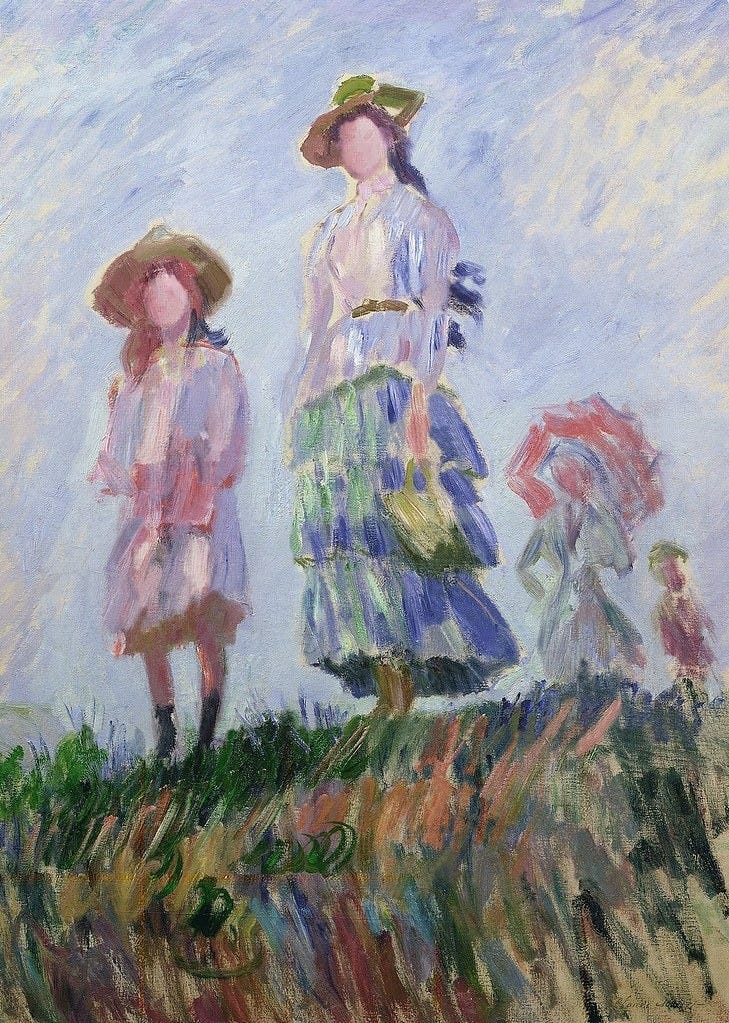
The Promenade (study), Claude Monet, 1886
1. Opening up new surfaces in relationships
Two weeks ago, I asked people to send me stories about situations where they had done what felt right to them, even though they feared social pushback.
Generously, more than fifteen people messaged to share their experiences, ranging from coming out as lesbian in Ireland to removing a headscarf in a Muslim community—one person recounted having his life changed by a sudden urge to stay in place when shot at with tear gas; another told the story of getting laid off from a tech job, spending six months living in their car while their friends worried and they slowly regained a connection with themselves that their work and life had disrupted.
It is one of the privileges of having this blog that I get to discover, again and again, how small the sliver of reality I’ve experienced is.
Several of the stories mirrored what I’ve felt in moments when I’ve done the socially awkward but inwardly aligned thing. People described how, despite some initial friction, acting from within brought a sense of lightness and relief.
As Hannah put it,
When you prioritize what you yourself value, everything around you shifts, and asserting that value creates a kind of gravitational pull on the world so that things, systems, relationships get a chance to find new arrangements. What surprises me so far is that my “demands,” contrary to what I expected, haven’t been a burden to others but have opened up new surfaces in my relationships.
But many people also had very different experiences from Hannah and me. When they gathered the courage to act on their own impulse—their own sense of what was right—they were punished. They lost friends, had to leave communities, and, in one case, were thrown out of their group house and ended up temporarily homeless.
What explains these different experiences?
2. Beth’s story
One of the stories that moved me deeply was from Beth.
Beth’s mother, who was dying of bone cancer, was very attached to Beth’s fiancé. He was a good and kind man. Beth’s friends adored him. But Beth, watching her mother struggle, realized she did not.
When Beth called her fiancé on the phone to seek comfort during her mother’s treatment, she noticed that she would always end up being the one who comforted him in his grief over her mother. This had been a pattern that had worn on her before—her role, it seemed, was to help him with his insecurities. And it was a pattern that recurred in many of Beth’s relationships—none of her friends had the patience to listen to the grief she felt for her mother; they wanted to talk about their own problems.
Beth says she might not have noticed this pattern if not for a new friend she’d recently met, who (to quote her)
showed care and listened to my pain and didn’t ask me to carry his. The contrast illuminated the position I had created for myself where I did not matter to the people closest to me except in how I served them. Once I realized that it felt wrong. I asked myself where I felt alive and able to hear my own thoughts and it was not with these people and these attachments and they confused me from hearing my own voice. I spent a lot of time alone, confused about what I wanted from my life but knowing I could not find it in these circumstances.
Meeting someone who could listen to her, and “the recognition of the kind of love that was possible,” gave her the courage to step out for herself. She decided to break off the engagement.
But then, she writes, “the worst did happen.” Her friends and family took her ex’s side. Her parents, disappointed with Beth, continued to call and visit him and tried to make Beth change her mind. Her friends talked behind her back and rejected her.
3. Reorienting your position in a group vs with individuals
I will return to Beth in a moment, but I want to get back to the question of why these kinds of decisions lead to deepened relationships in some cases and rejection in others.
One obvious answer is that it depends a lot on how open-minded people you are interacting with are.
But perhaps a more interesting answer—or at least a pattern in the cases I heard—is that things tend to go badly more often when people try to reorient their relationship toward a group, rather than toward individual people.
It made me think of something my friend Alex once said. The context was that he was frustrated by the attitude of a group he’d given a presentation to. I asked him if he thought it might be good for them to know that what they’d done had made him mad. And he said, “That would require a level of emotional maturity that I gladly ascribe to many people. But certainly once you get into groups of people, the odds go way, way down.”
This fits with the stories I heard. When dealing with individuals, people could (almost) always find a way to reach common ground and create, as Hannah put it, “new surfaces in the relationship.” But with groups, there was a whole set of social dynamics that made people turn on whoever challenged the status quo.
Those who had good outcomes in group contexts often didn’t address the group as a whole (at first), but instead had conversations with individual members of the group one-on-one so that they could, in more incremental steps, update their relationships and gather support.
4. Disagreeing warmly
Navigating social dynamics requires a lot of skill, especially when you’re going your own way and want to minimize conflict. The difference in these skills, I suspect, is another reason why some people find it easier to go their own way than others.
One person I chatted with, a French engineer, made an interesting observation about three disagreeable men at their workplace. All three are vocal when they have differing perspectives on issues, the engineer told me. But two of them are well-liked by their colleagues, while “the third seems to build up resentment internally and to sometimes offend and alienate people,” even if his disagreements are “still often quite beneficial.”
None of them are selfish. They all defend what they believe is globally good according to their values. The main difference is that the two who handle dissent well are extremely warm people. They wear their hearts on their sleeves. It’s clear that they deeply care about people and can make space internally for negative feelings. The less skillful one is more analytical, more cold. He cares about people but in a less embodied way. And generally, I guess he’s worse at reading the room and making space for others.
Talking this over with my wife Johanna, she observed that when you are not able to process your negative emotions—and instead let feelings like frustration, vindictiveness, and hurt bleed out into the conversation—it makes it much harder to talk about difficult things. Dealing with a disagreement, or a situation where you need to update how you think about something, is hard in itself. If you are at the same time asked to deal with someone else’s feelings, that might be too much to ask. People get infected by the nervousness or frustration or cageyness, and then their capacity to process new information goes way down, and you end up polarized.
This doesn’t mean that you shouldn’t voice your perspective if you struggle to contain your emotions. It just means that if you can process your own feelings, you will be more effective at voicing your needs and perspectives.
Going your own way is a bit like playing a countermelody when jamming music with others. If you are just playing along, filling in the same melody as everyone else, you don’t need a lot of skill. But the more dissonant your ideas are, the more skill it takes to make them work. There is a clip of Jacob Collier where he talks about this and demonstrates how there are no “wrong notes” you can play in a song: you just have to figure out how to bring them home—how to resolve the notes in a way that makes sense with the overall music. But if you want to do something really spicy, you need to deeply understand what everyone else is doing (you need empathy), and you need to be attuned to yourself, so you can find an elegant way of weaving the off-scale melody into the harmony.
5. Coda
So let me bring this all home by giving you the coda of Beth’s story.
After Beth had broken off her engagement and had to face her parents’s hurt and disapproval, she felt that the hold they had had over her gave way. She was still “kind to them and loved them and respected many things about them,” but they didn’t enter into her calculations anymore.
After a few months, when it was clear that Beth wasn’t backing down, her parents stopped trying to change her mind. They continued to call and visit her ex, but they didn’t involve her in their attempts to maintain the bond anymore and eventually stopped.
There was a long period where she struggled to make sense of the implications of the choice she had made, and what she wanted to replace her old life with. It is easier to know that something isn’t right than it is to figure out what to replace it with. But over time, the act of paying attention to how she felt and making choices aligned with that helped her develop “a better ear for [her] desires” and grew her “ability to make choices based on a clear understanding of [herself] and [her] own values.”
Beth realized that she was in love with the friend whose openness and care had given her the courage to go her own way, and eventually, they decided to get married. It was tough for him, she says, to be brought into this situation, especially with Beth’s mother undergoing aggressive cancer treatment. But he was so helpful “that it softened things,” and Beth’s mother accepted him as part of the family.
“I also don’t discount what facing death did to my mother’s willingness to change her very strong opinions and let me live my life without fighting it,” Beth writes.
Overcoming the difficulty of the situation for Beth required acknowledging the pain of her decision and “also recognizing the freedom that [she] acquired in making that choice.”
By asserting myself in this way, I also fundamentally remade my relationship to those who mattered and discarded the rest. My mother ultimately came to love my current spouse and was able to participate fully in our wedding before she died two months later. The decision felt at the time like a leap into the unknown and abandoning social safety, but in reality I gained a deeper safety that has provided a more secure foundation for building a flourishing life.
Acknowledgements + chat
I feel immense gratitude and care for everyone who was willing to share their stories and reflections. You know who you are. And a special thank you to Johanna, whom I always turn to when I need to think things over, and who probed me to make serious revisions of the current essay. And Esha Rana, who did the copy edits.
This essay—like all my free essays—was entirely funded by the contributions of paid subscribers. If you enjoyed it, give them your thanks, and if you can spare $8 dollars per month, consider joining them:
Here is a separate chat for paid subscribers if you want to discuss today’s essay in a more private setting. I think I will need to write another essay about the emotional work necessary to deal with these types of social frictions, but I feel like I’m too stuck in my own life experience to say much that is generally useful; I would love to hear from (and talk this over with) more people.
/Henrik
Wow! Henrik, I love this piece. Love how you use your ability to connect dots and themes and patterns but with other people’s experiences. Such a neat concept and I feel that you nailed it. Congrats!
My favorite was this: “Going your own way is a bit like playing a countermelody when jamming music with others. If you are just playing along, filling in the same melody as everyone else, you don’t need a lot of skill. But the more dissonant your ideas are, the more skill it takes make them work.”
I’m a big sucker for a good analogy and i really loved the visual you gave to this idea. I also am a fan of when you talk about the work and effort it takes to go against the crowd. You have a lot of lived experience with that, and so your words on the topic bring great value.
Appreciate you and your work Henrik, thank you!
I was re-reading your piece on Grothendieck last night before this post was released. Even pulled up the original version in French and read it from a few different angles to get a feel for the translation. So I couldn't stop thinking of him while reading this. Especially when you mentioned orienting one's relationship toward a group.
This is the consensus and law he was talking about, I believe.
""when I was thrown onto my own resources, following guidelines which I myself had spontaneously invented, instilled in me a strong degree of confidence, unassuming yet enduring, in my ability to do mathematics, which owes nothing to any consensus or to the fashions which pass as law...."