

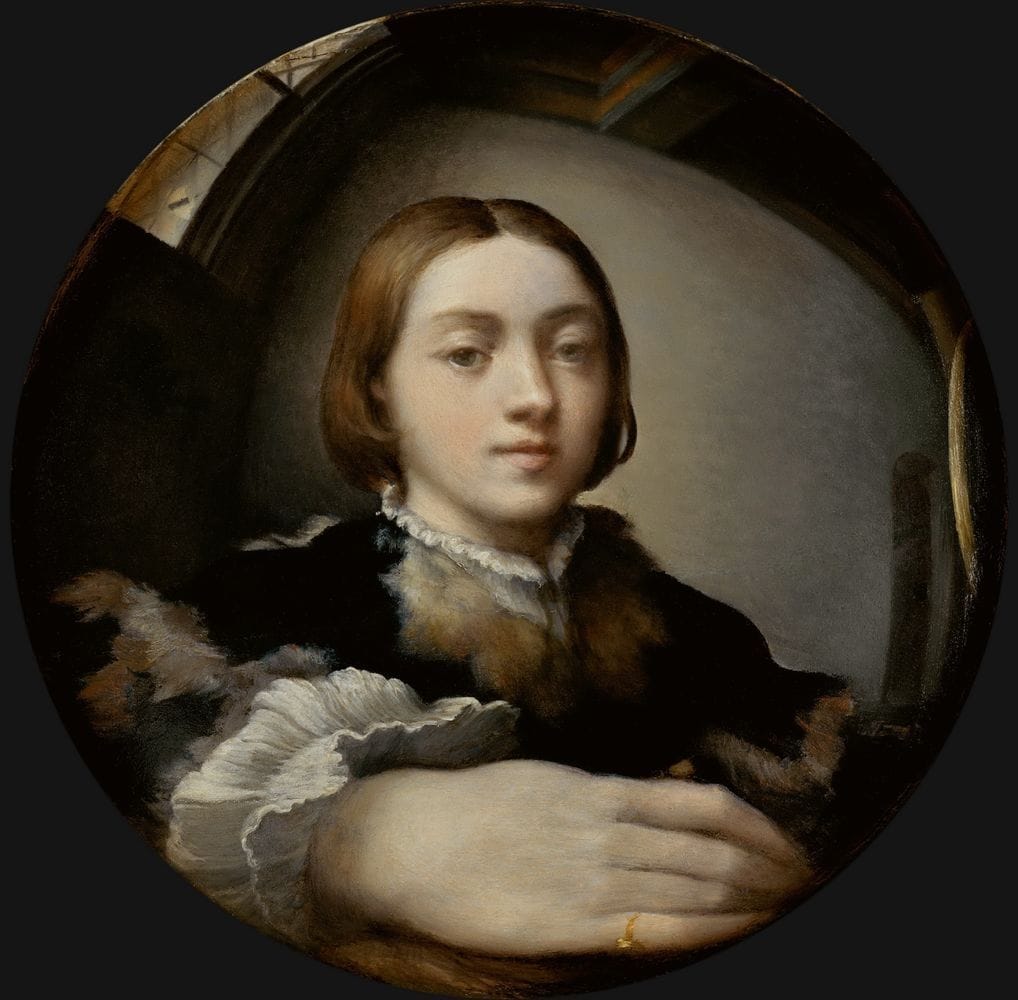
Self-Portrait in a Convex Mirror, Parmigianino, c. 1524
An interesting thing I noticed when I reread some of my old diaries last year was that, in terms of writing quality, there was a very sharp capability jump in 2019. By which I mean that when I read what I wrote in January 2019, I felt vaguely embarrassed, but when I read what I wrote in October, I really liked it. I don’t mean to say that I suddenly learned how to write from one month to the next; I had written seriously for something like 12 years before this point. But in all the years I’ve written, I’ve never improved as rapidly as I did in 2019.
I have a theory for why that is. In April of that year, I picked up the habit of indexing my journal. The thought behind this was that it seemed wasteful that I wrote all of these interesting things in my diary (things that I found interesting enough to write down, anyway), but then never thought about them again because I couldn’t remember where I had written them, if I even remembered that I had written them. So, I started to number the pages, and every few weeks, I would go over what I had written, mark up the interesting parts, and make a note in an index on the inside of the cover, such as Philip Glass: p. 11-13, 43, 67.5 [adding “.5” meant the righthand side; to save time, I only numbered the lefthand page].
The index had the desired effect. It made me reread, rediscover, and remember things I had enjoyed or found meaningful in the past. But it also, as I said, unintentionally made me a better writer. Why is that?
One explanation could be that, as Hemingway supposedly put it, “the only kind of writing is rewriting”: you learn to write, and write well, by going over your sentences, improving them. But although I did a small amount of rewriting and editing when I reread my journals, I don’t think that was the main thing that was making me improve—I’m no Lydia Davis who compulsively corrects every sentence she rereads in her notebooks until she can’t think of a better way of putting it. I was just casually reading. And most of what I read wouldn’t even be interesting enough to warrant editing, especially the parts where my tone indicated that I was performing for an imaginary audience—these parts I would just flip past. I skimmed a lot.
But here and there, I would stumble upon a passage that made me light up. And then I would linger; I would scribble notes and annotate it so that I’d reread it again. I was providing myself with feedback about what I like.
And what seems to have happened next is that I became audience captured by myself. In the months that followed, I began to alter my writing to satisfy the tastes of my audience, i.e., myself in a few weeks—like those YouTubers who develop deranged personalities because it is rewarded by their audiences. I wasn’t aware of changing; the only thing I noticed was that writing was becoming more fun. But rereading the record, I can clearly see that I was getting better and better at guessing what would make me skim (and so wrote less of that) and what I would be delighted to re-read (and so wrote more of that). I also had more delight-inducing thoughts; I became an obsessive spotter of things that would make for good rereading—passages from books and scenes from my life and passing reflections that excited me. If there is a feedback loop reinforcing a behavior, it is hard not to go in the direction that improves the score.
A big shift in post-2019 diaries, compared to my older diaries, was that I focused on what I wanted to see more of, to use Visa’s phrase. The amount of time I spent writing about things I dislike, ruminating on my problems and so on, went way down—that sort of stuff was no fun to read. But when I read the vignettes I wrote about Maud, our two-year-old, I would laugh, “I should write more of those!” And so, I started to pay closer attention to her during the day, and made more notes—more reminders to my future self.1
Or I would read a short reflection I had made when reading Michael Nielsen’s note about Imre Lakatos’ Proofs and Refutations, and I’d go, “Oh, I’d forgotten about that. That is interesting. I should get that book.”
By returning to what gave me joy and a sense of meaning again and again, exploring it in greater and greater depth, I would improve my feel for what clicks for me. I was refining my taste.
The feedback signal I was training against was clear and strong. Since I knew no one else would ever read what I wrote in the journal, the only thing that interested me as I indexed was whether the writing made me excited or not. There was no interference from social expectations and other things that make it harder to tune in to what I like when I, for example, write an essay. And there was little ego involved, so there were none of those strong emotional reactions (feeling pride at success and shame at failure) that distort the feedback signal (making me overreact emotionally and/or come up with excuses to protect myself). It was just some notes I stumbled upon, notes I could barely remember having jotted down, and so I could look at them with sober detachment. The gradient of improvement was smooth.
The deeper lesson here is not that indexing your journal will make you a better writer. It might; I don’t know. The lesson is that the feedback loops that we let work on ourselves shape us to an unsettling degree. And often we’re not even aware of being in a feedback loop, nor what that feedback loop reinforces in us. It is worthwhile to think about what you value and want to see more of, and prune the feedback loops that push against that, and sculpt new ones that support you.
The title of this essay is shamelessly plagarized from an old essay of mine, which shamelessly plagiarized a famous Churchill quip about architecture:
First we shape our social graph; then it shapes us

This essay is the first of a series. Here is part 2, part 3, and part 4.
Reflections on how and why I wrote this essay
This essay was written between Friday, August 14, 2026, and Wednesday 26, primarily in my car, parked on a small gravel patch facing the sea.
The impetus for the writing was a conversation I had with Johanna a week earlier where she was telling me about dog training (we’re thinking about getting an Italian greyhound). When you look at how moldable the behaviors dogs are, you start to wonder about yourself. How am I being shaped by the conditions I’ve put myself in, by the rewards and punishments that my environment feeds me? In relation to my writing and thinking: are the feedback loops I’m inside pushing me toward the kinds of thoughts and words that I want to think and write? Or are there ways I could alter my environment to push me toward better, deeper, more true and good and beautiful thoughts and experiences and behaviors and words?
I haven’t been able to process these questions fully and answer them in a way that satisfies me yet. But in thinking about it, this little essay fell out.
My thoughts have been shaped by several conversations with Johanna Karlsson, Viktor Lysell Smålänning, Andy Matuschak, and Michael Nielsen. Johanna did a lot of the work of shaping my initial sprawl of ideas into a coherent essay.
Remember when we woke up Maud at midnight and went out to lie on the asphalt, eating popcorn and looking up at the stars?
Remember how she would cry each morning for a week after because we hadn’t shown her the stars again?
This was an awesome piece Henrik! First one I'm reading from you but this was such a high quality idea-- read over our own stuff, see what we like, ignore the rest... Damn. You're so right (no pun intended haha). I'll definitely be taking a weekend to do this! Omg thank you for this brilliant idea and I'm so grateful it worked out so well in your life. This was a really nicely written post and you've got a very warm, welcoming writer's voice, like you're at a podium not a pedestal and I can trust your words without idolizing them. That's awesome man that you're 12 years in the making too! I've been writing for 10 :D
Keep at it! Seriously, I don't know why this post didn't receive the same recognition all your other ones have???
Such a lovely articulation of the joy and worth of having a journal. It’s convinced me to move back to a journal with no lines, to mix and match stories, drawings, and reflections and worry about sorting them later.
I’m so thankful for your writing—I almost always leave with something concrete. I hope your writing continues to bring you new kinds of giddy exploratory pleasure! I’m certainly “captured” by it.