

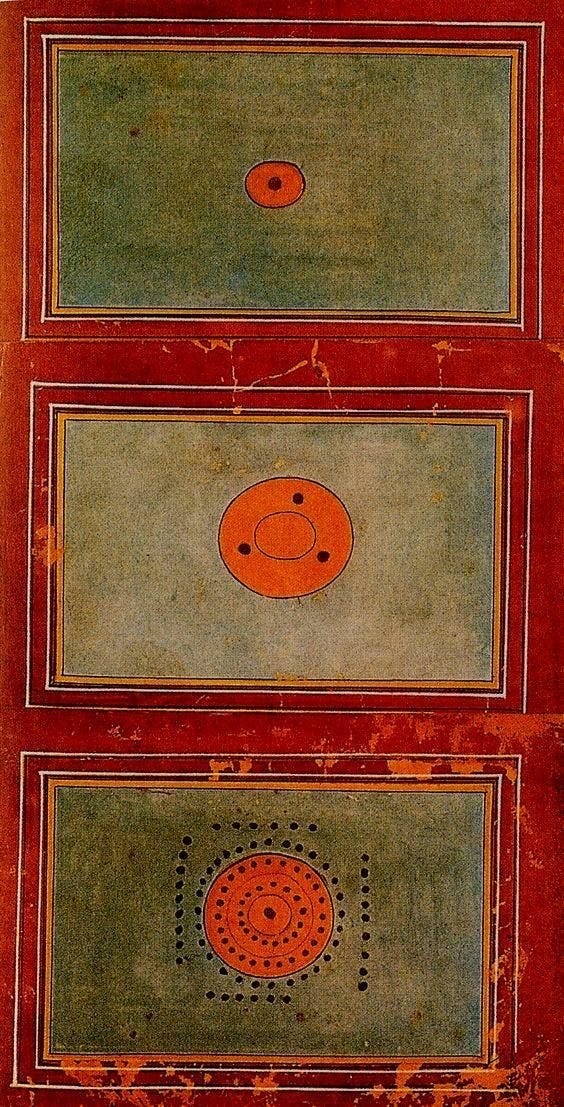
Evolution of the Cosmos from a single point (Bindu), c. 1700
Since I began working on this essay three hours ago, around 21,000 people have, statistically, died. Now the sky is low and cloudy; I’m feeling tired, and looking at the numbers, I learn that about 10 million people are having sex as I type this sentence.
It can be hard to appreciate just how large each moment of each day is, how much more is going on than we experience.
Even just thinking about the fact that every place I’ve ever visited still exists (however reconfigured) gives me vertigo. In the medical factory where I worked at 21, the production lines are still going, and have done so, more or less continuously, for the 15 years since I last thought of them. There are people living in every house and apartment I’ve ever stayed in: if I were to go back and peek through the windows, I’d see them, as real as I. Also, everyone I’ve ever been on a date with is—I hope—still alive, somewhere, occupied with a life that feels like the world to them. And everyone I’ve worked with, or met on a bus, or been to school with.
I think about this, or rather I feel it—the heaviness of it—as I read the first six books of Solvej Balle’s On the Calculation of Volume. It is one of the more moving experiences of art I’ve had this year.
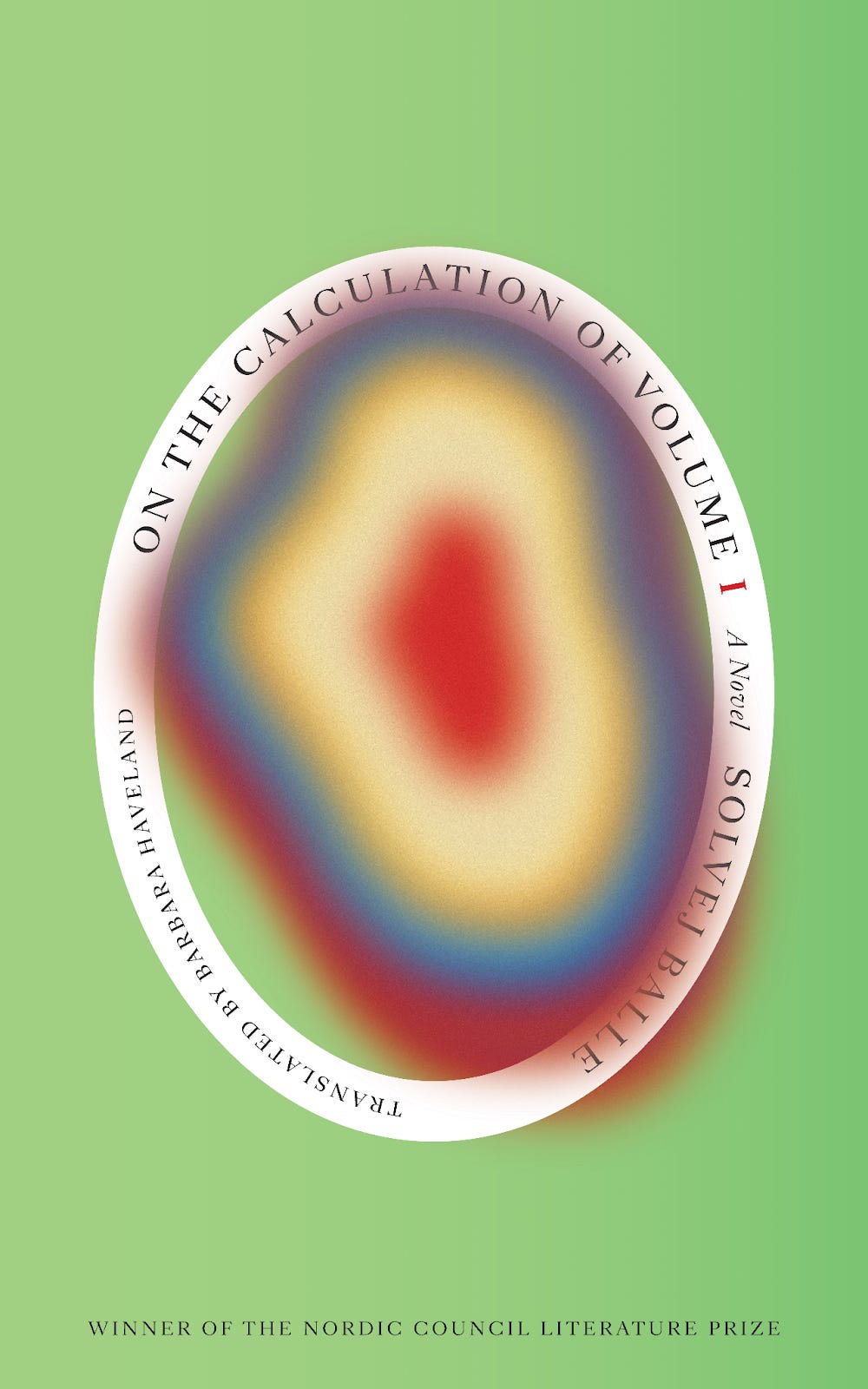
The premise of Balle’s novel series is, for those who haven’t read it, that the same day—November 18th—repeats over and over. Every morning a piece of French toast falls from a table at a hotel in Paris. The same football team wins the match in the same way, and the fans get drunk at the same bar. In an apartment in Clairon-sous-Bois, a man boils tea in the morning, always in precisely the same way at precisely the same time. And a girl sits on a train crying after being dumped, over and over again. The clouds retrace their paths across the sky.
Only one person, Tara Selter, whose diary we are reading, notices what is happening. Only she is not trapped in an eternal return. She can do whatever she wants. She is free to change.
Because we cannot move freely in the dimension of time, we experience reality as a series of three-dimensional moments succeeding one another. But if we could observe spacetime from the outside, reality would look like a 4-D object with time as its fourth dimension. Every chair and stone and person would reveal itself as a so-called world line—a four-dimensional object extending through time. In the same way that we can walk around a sculpture and see it from different angles, we would be able to observe the sculpture’s world line at different points in time—in the morning light, in the moment a child tries to climb the sculpture, in the moment the sculptor carved it, three hundred thousand years earlier, when the stone lay hidden in the bedrock. The sculpture would reveal itself as the four-dimensional object that (I’m told the theory of relativity says) it always was.
Something similar happens in Balle’s series.